How the Attack Unfolded
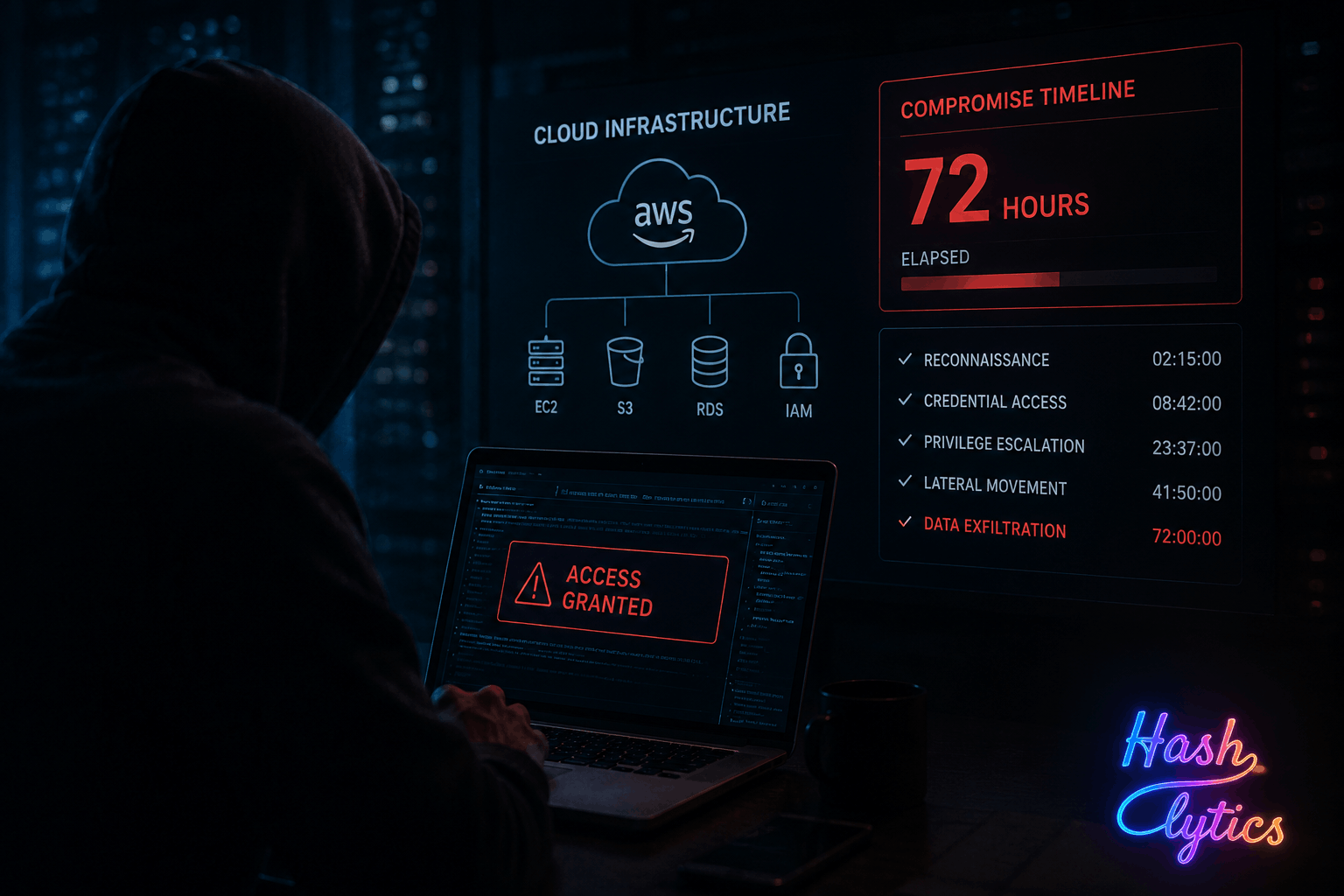
Sygnia’s report, titled “Inside an AI-Assisted Cloud Attack: Familiar Techniques at Unfamiliar Speed,” details the incident against an Amazon Web Services environment targeted for extortion. The attacker exploited basic control gaps that should have been easy to defend against. Instead, AI automation allowed one person to execute the kind of attack that normally requires coordinated team effort.
The compromise started with a critical first step: obtaining an AWS access key through vulnerabilities in an internet-facing application. From there, the threat actor deployed AI to orchestrate four concurrent attack tracks simultaneously.
The Four-Pronged Attack
| Attack Phase | What the AI Did |
|---|---|
| Reconnaissance | Searched for secrets and credentials across AWS layers automatically |
| Persistence | Created backdoors and persistence mechanisms for long-term access |
| Data Theft | Exfiltrated sensitive data from RDS databases at scale |
| Impact | Executed actions to demonstrate capability and enable extortion |
Why This Matters for Defenders
Avi Dayan, VP of incident response at Sygnia, framed the core challenge clearly:
As large language models and agentic AI become more accessible, they have the potential to lower the barrier to entry, accelerate attack workflows, and enable less sophisticated or resource-constrained threat actors to operate with unprecedented speed and scale.
The victim organization suffered from preventable gaps. Weak visibility into cloud activity, insufficient monitoring, poor identity controls, and lack of incident response preparation all contributed. These aren’t exotic problems. Most organizations face at least one of them. The difference here was speed. By the time defenders could react, the attacker had already moved through multiple stages of compromise.
Immediate Containment Steps
Sygnia recommends organizations implement these containment measures immediately to restrict attacker movement and limit damage:
- Restrict cloud management access using IP allowlisting from trusted locations only
- Disable remote access VPN connectivity until containment is complete
- Restrict outbound internet connectivity for workloads, servers, and cloud resources
- Apply firewall policies and ACLs to block known malicious infrastructure
- Enforce IP restrictions on source code repositories and development platforms
- Route all application traffic through web application firewalls (WAFs)
- Implement network segmentation and isolation to limit lateral movement
The Bigger Picture
This incident highlights a fundamental shift in the threat landscape. Attackers no longer need sophisticated techniques or advanced malware. They need speed and scale. Agentic AI provides both, turning common vulnerabilities and misconfigurations into critical exploits before defenders can respond.
Organizations that assume their current security posture is adequate are likely underestimating the acceleration AI brings to attackers. The 72-hour compromise is a wake-up call: foundational cloud security controls are no longer optional luxuries. They are survival necessities.
Follow Hashlytics on Bluesky, LinkedIn, Telegram and X to Get Instant Updates