+1.04%
+0.60%
+0.00%
+0.05%
+6.04%
+0.88%
Where the Numbers Stand Right Now
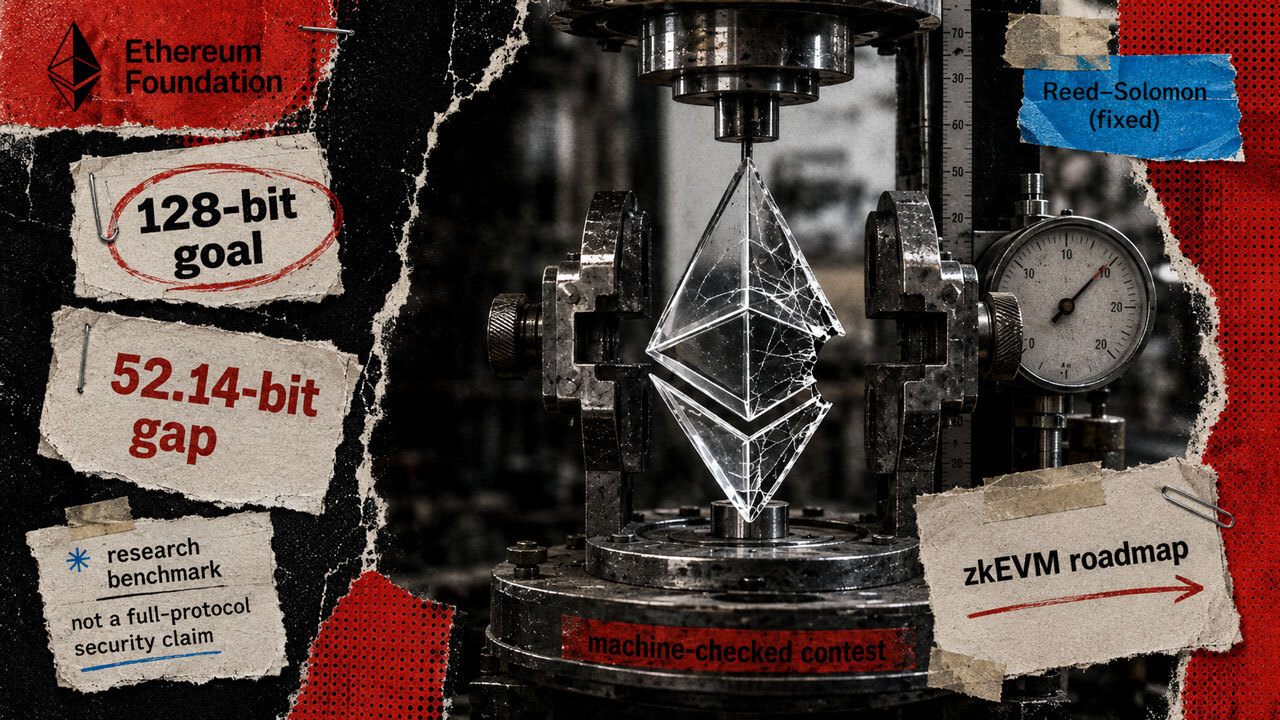
A live leaderboard on better.codes, a cryptographic proof contest, tracks the current progress. As of August 21, the koalaIRS12 profile showed a 63.99-bit lower certificate and a 116.13-bit upper certificate, leaving a 52.14-bit interval still unresolved.
| Machine-checked result | Live score | Certified scope |
|---|---|---|
| Soundness lower certificate | 63.99 bits | Conservative safe point for koalaIRS12 |
| Attack upper certificate | 116.13 bits | Unsafe suffix for the same parameter profile |
| Open interval | 52.14 bits | Distance between the promoted certificates |
| Ethereum M3 requirement | 128 bits | Full zkEVM provable-security target |
KoalaIRS12 is a fixed parameter profile for an interleaved Reed Solomon reduction. This benchmark helps measure progress in proof-system research and gives teams a concrete number to chase rather than an abstract goal.
Two Tracks Push the Gap Closed From Both Sides
The better.codes contest uses two tracks working in opposite directions to narrow this interval.
- Soundness track: Aims to raise the lower certificate. Successful submissions prove the benchmark’s executable reduction-error bound meets its target.
- Attack track: Works to lower the upper certificate by certifying an unsafe suffix under specific conditions, giving researchers a formal boundary for koalaIRS12.
Together, these two tracks squeeze the uncertainty from both directions until the gap eventually closes.
A Single Number Won’t Finish the Job
While the leaderboard tracks specific component-level progress, full production assurance requires more than hitting one target number. The Ethereum Foundation emphasizes covering model completeness, embedded assumptions, and implementation fidelity. How separately analyzed components combine into a working system matters just as much as any individual score.
A May review of an SP1 formal verification effort highlighted these additional layers in detail. Specifications and theorem statements get treated as code in this process, and inputs and versions require reproducible pinning to keep results reliable across different testing runs.
What Still Has to Happen Before December
The Ethereum Foundation’s zkEVM security roadmap calls for 128-bit provable security by December 2026. That target also includes a final proof size capped at 300 KiB, along with a formal soundness argument for the recursion architecture.
Teams still need to connect these component bounds to an auditable system package. For koalaIRS12 specifically, reaching a 128-bit lower certificate would settle its soundness question entirely. But a production zkEVM needs broader accounting across every relevant component, not just this one benchmark.
The current 52.14-bit interval represents real, unfinished work. Whether Ethereum’s 128-bit production case comes together on schedule will depend on how this component evidence integrates into the larger system proof over the coming months.
Follow Hashlytics on Bluesky, Facebook, LinkedIn , Telegram and X to Get Instant Updates