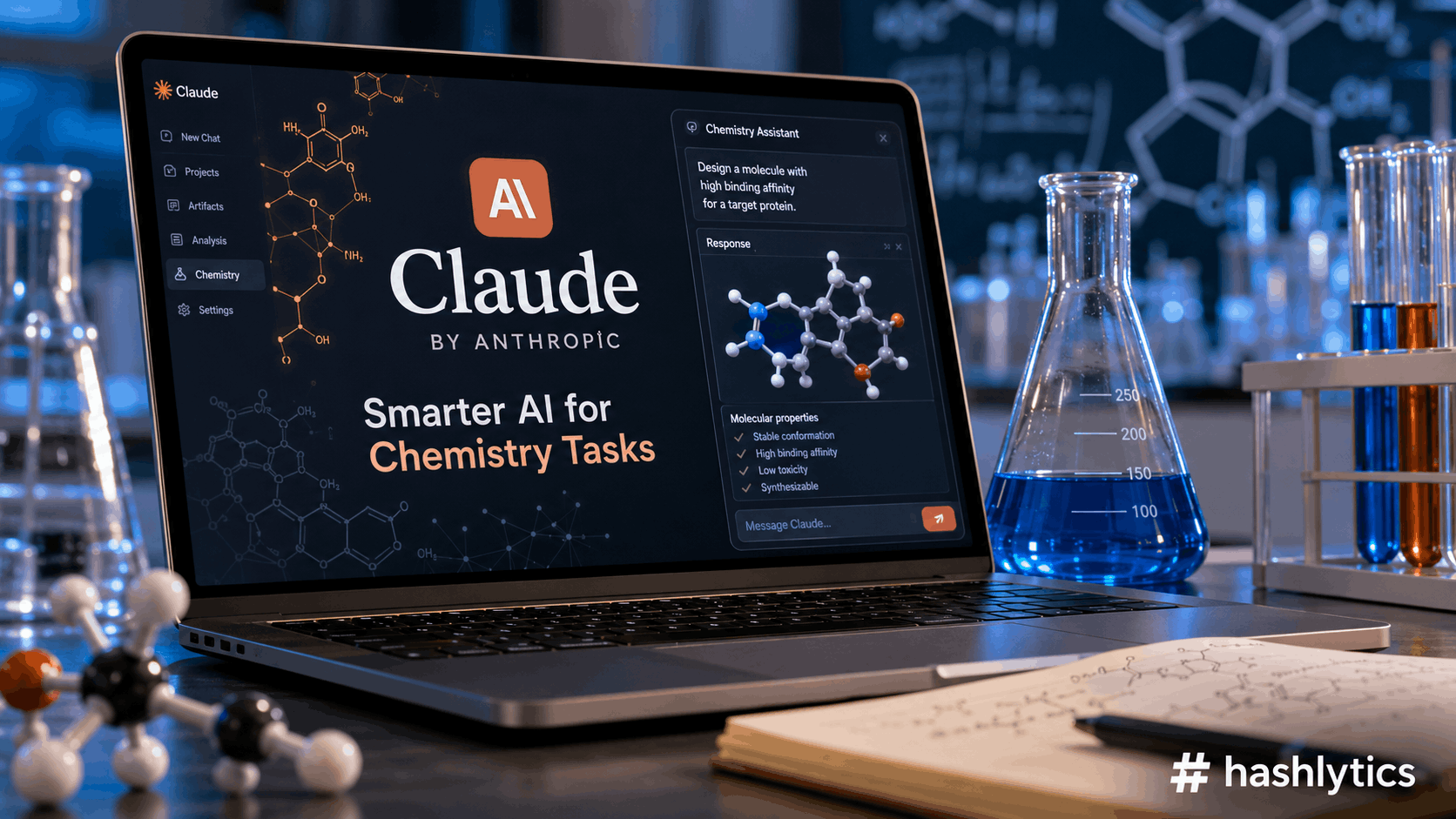
Anthropic is significantly advancing its Claude AI models to tackle complex chemistry tasks, demonstrating a new frontier for artificial intelligence in scientific research. The company has published initial findings from a collaborative effort with synthetic, computational, and analytical chemists, showcasing Claude’s ability to interpret Nuclear Magnetic Resonance (NMR) spectra, a fundamental analytical tool in chemistry.
Claude Opus 4.7 Excels at NMR Analysis
A recent white paper details how Anthropic chemist David Kamber assessed Claude’s performance on NMR spectrum analysis. The study compared Claude models (specifically Opus 4.7, Opus 4.6, and Sonnet 4.6) against industry-standard software like ChemDraw and MestReNova across two critical tasks: forward prediction (predicting an NMR spectrum from a molecular structure) and inverse prediction (determining a molecular structure from an experimental spectrum).
The evaluation used twenty compounds sourced from ChemRxiv preprints published after the models’ training cutoff, ensuring an unbiased assessment. Claude Opus 4.7 delivered strong results, achieving an average error of plus or minus 0.079 ppm for hydrogen prediction, well within chemists’ acceptable tolerance. For carbon prediction, Opus 4.7 and MestReNova were effectively tied in accuracy.
Chemists routinely navigate diverse molecular representations, from hand-drawn sketches to instrument readouts and database queries. This translation process consumes significant time and resources, especially given scale challenges. The CAS registry alone catalogs over 290 million substances, growing by approximately 15,000 daily.
Traditional machine learning approaches have promised breakthroughs in areas like retrosynthesis and reaction prediction, but adoption has been uneven due to data scarcity, inconsistent formats, and paywalled access. Claude’s multimodal capabilities and explicit reasoning offer a different approach. The model can interpret chemical structures directly from journal figures or sketches and read experimental details as published. This allows chemists to audit AI outputs step by step, enhancing trust and utility while human judgment remains central to the process.
Performance Benchmarks
Anthropic’s detailed white paper, available here, highlights Claude Opus 4.7’s competitive performance across key metrics.
| Capability | Claude Opus 4.7 | Traditional Software |
|---|---|---|
| 1H Forward Prediction | ±0.079 ppm accuracy | ChemDraw, MestReNova comparable |
| 13C Forward Prediction | ±1.37 ppm (tied with MestReNova) | MestReNova: ±1.48 ppm |
| 1D NMR Inverse Prediction | Highly successful on simple structures | Typically requires 2D NMR and specialized training |
| Splitting Pattern Matching | More frequent accuracy | Lower frequency |
| Sub-peak Spacing | Approximately 80% within 0.5 Hz | 26-35% within 0.5 Hz |
Strengths and Current Limitations
Claude’s initial foray into chemistry demonstrates significant potential alongside clear areas for improvement.
What Claude does well: It delivers competitive accuracy for 1D NMR forward prediction against specialized software. Its unique ability to perform 1D NMR inverse prediction represents a complex task typically requiring dedicated tools. The multimodal reasoning can read structures from figures and sketches while processing experimental details, and step by step reasoning allows chemists to audit outputs and understand how the AI arrived at conclusions.
Current constraints: The evaluation remains relatively small with only 20 compounds for forward and 15 for inverse testing. Performance on denser inverse targets improves when given starting material hints. Coverage is limited to three solvents (DMSO-d6, CDCl3, and D2O). The model does not yet handle 2D NMR experiments or stereochemistry, limiting analysis of complex natural products.
Anthropic is committed to enhancing Claude’s chemical capabilities by addressing several key bottlenecks. These include improving the AI’s ability to read and render chemical structures, refining reaction and synthetic reasoning, explaining reaction mechanisms with electron arrows, and understanding complex chemical literature. While spectral analysis is mature enough for benchmarking, other areas like retrosynthesis planning remain in early stages.
The ultimate goal is empowering working chemists by clarifying where Claude can save time and where human expertise remains essential. Anthropic is expanding its AI for Science program and invites researchers working on problems where Claude’s multimodal reasoning could assist to collaborate.
Follow Hashlytics on Bluesky, LinkedIn, Telegram and X to Get Instant Updates