+0.67%
-0.30%
-2.44%
-3.88%
-1.19%
+4.51%
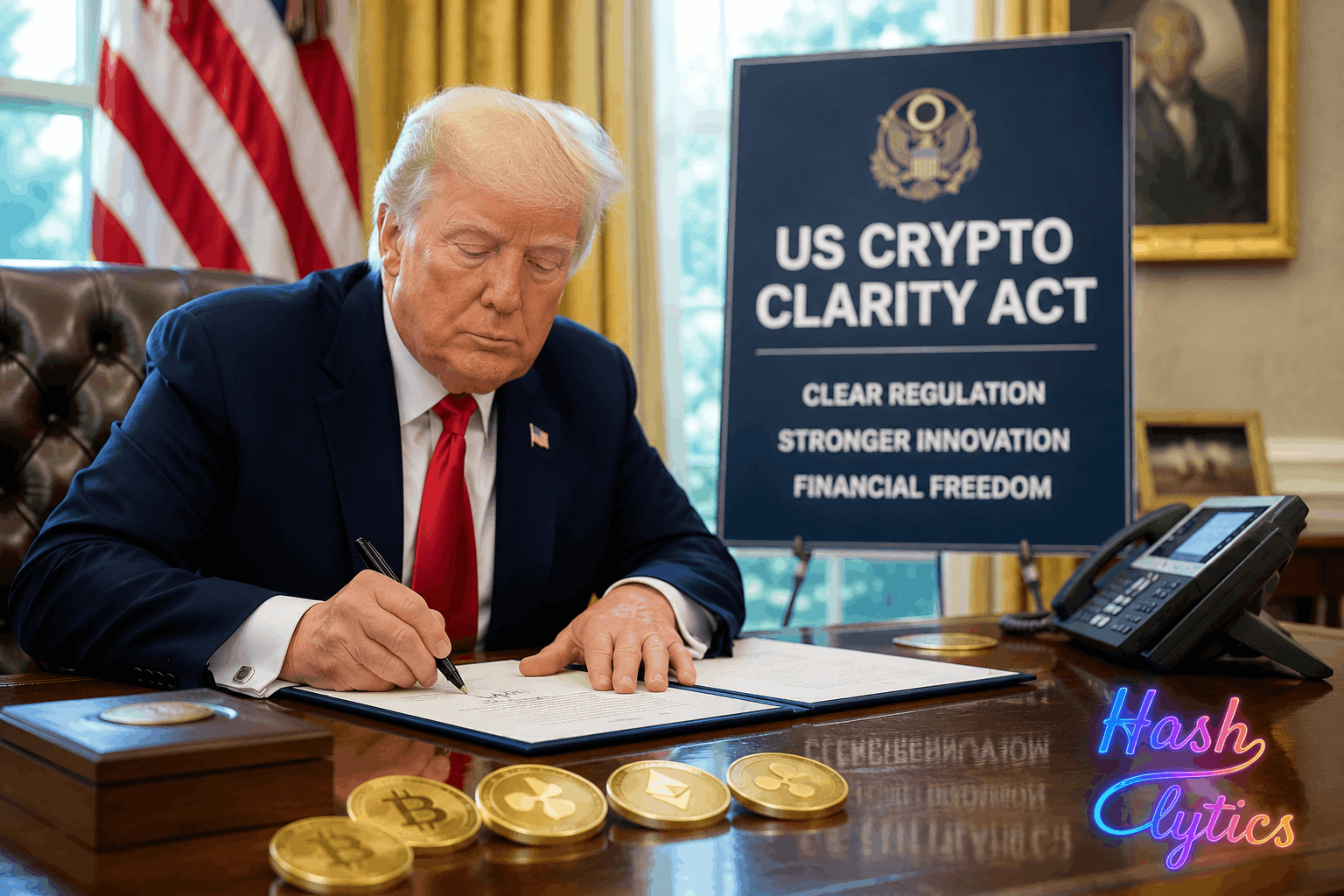
The comment adds significant political weight to momentum building around H.R. 3633, which passed the House in July 2025 and advanced through the Senate Banking Committee in May 2026 with bipartisan support. The bill now faces a critical test: securing 60 votes in the Senate before the August recess.
Trump’s Direct Call to Action
Trump’s endorsement specifically referenced Senator Lindsey Graham, a key bill supporter. In his post, Trump wrote: China, and many other countries, would like to take complete and total control of this major financial ‘happening,’ as well as AI, where we are now leading, but where they are fighting hard. Don’t let China win on either subject.
The former president framed crypto regulation not as a matter of industry preference but as essential to American competitiveness in global finance and technology.
What the CLARITY Act Does
The bill creates a comprehensive regulatory framework for digital assets by clarifying which cryptocurrencies fall under SEC jurisdiction and which are regulated by the CFTC. Key provisions include:
- Clear legal definitions separating securities from commodities in the crypto space
- Custody rules for digital asset platforms
- Anti-money laundering (AML) and Bank Secrecy Act (BSA) requirements for exchanges
- Consumer protection standards
The bill passed the House with bipartisan backing and advanced through the Senate Banking Committee 15-9 in May 2026, including support from two Democrats. Senator Cynthia Lummis and other proponents argue the legislation is vital for consumer protection, preventing regulatory overlap, and maintaining U.S. competitiveness in digital assets.
Mounting Opposition and Declining Odds
Despite early momentum, the bill faces headwinds. Polymarket data from earlier this month showed passage probability has dropped sharply to 39 percent, reflecting skepticism about whether the bill can secure the 60 votes needed to overcome a potential filibuster.
JPMorgan CEO Jamie Dimon has become a vocal critic. In a Fox Business interview, when asked about his satisfaction with the bill’s direction, Dimon answered simply: No.
His core complaint centers on provisions allowing crypto firms to offer yield on stablecoins and deposits without the same regulatory safeguards traditional banks face.
Dimon argues the legislation provides insufficient anti-money laundering, Bank Secrecy Act, and customer protection standards. He views the current proposal as regulatory arbitrage that gives crypto platforms an unfair competitive edge over traditional financial institutions.
Industry and Regulatory Support
CFTC Chair Mike Selig has backed the Senate Banking Committee’s advancement of the act, calling it a major step toward making the United States the crypto capital of the world. Industry leaders and crypto advocates view clear regulation as essential to unlock institutional investment and mainstream adoption.
Negotiators are reportedly working to address remaining concerns as they push for a floor vote before the Senate recess in August. The outcome will likely determine whether America can establish a competitive regulatory framework for digital assets while maintaining financial system safeguards.
The central question facing the Senate: can lawmakers balance innovation with investor protection, or will competing visions of crypto oversight prevent passage of the Clarity Act before summer recess?
Follow Hashlytics on Bluesky, LinkedIn, Telegram and X to Get Instant Updates