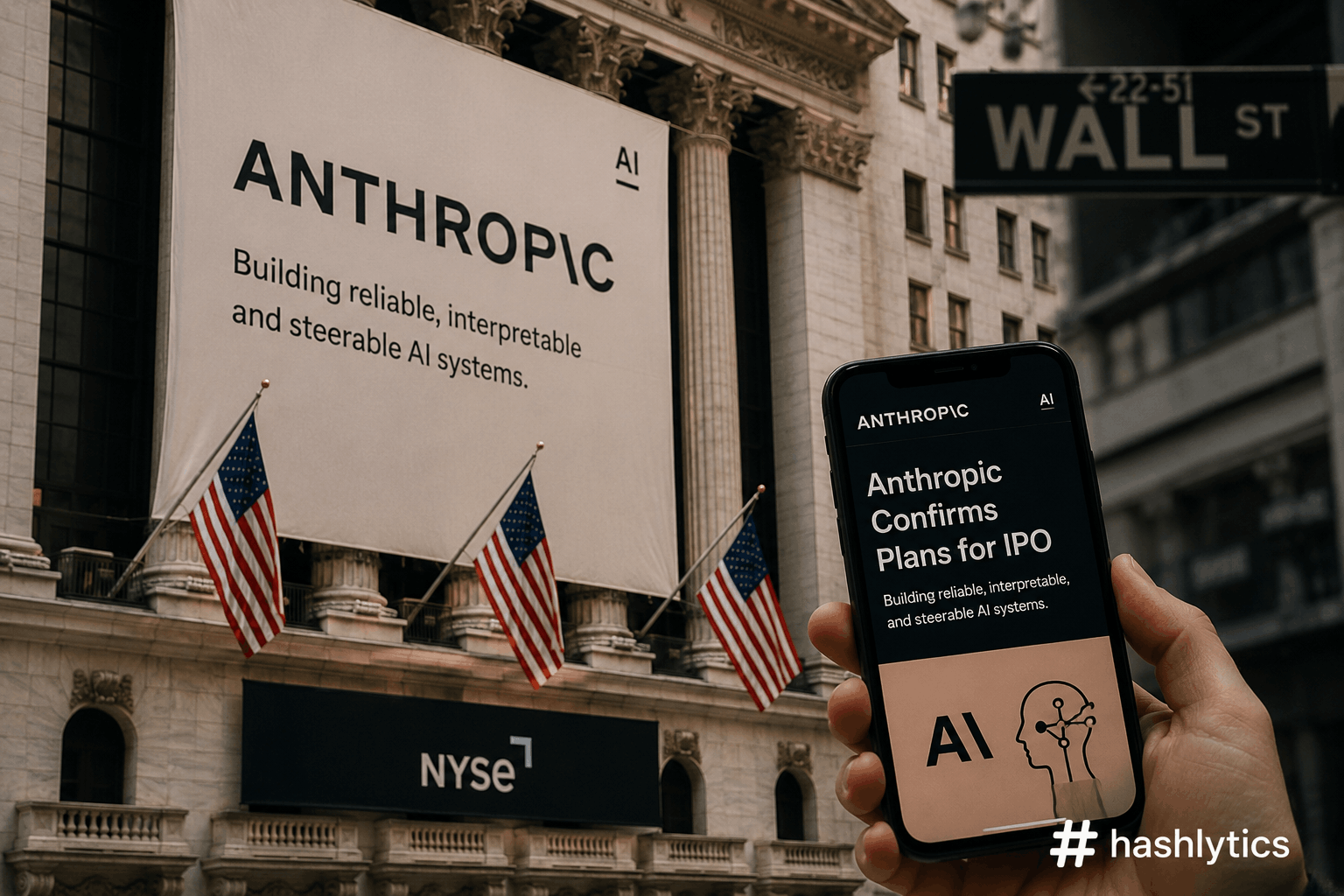
Anthropic’s explosive revenue growth just found its logical endpoint. The Claude maker confidentially submitted a draft S-1 registration statement to the SEC on June 1, 2026, officially entering the race for what analysts are calling the most consequential tech IPO wave since Google’s 2004 debut. The move comes two weeks after SpaceX’s public S-1 filing, days ahead of OpenAI’s anticipated confidential submission, and follows months of concern about AI backlash threatening both companies’ public market plans. No share count, no price range, no timeline, just two paragraphs of boilerplate and a bombshell.
The Numbers That Made This Inevitable
Anthropic’s annualized revenue run-rate recently crossed $47 billion, fueled by enterprise adoption of Claude for coding and agentic workflows. The company closed a $65 billion Series H round in late May 2026, led by Altimeter Capital, Dragoneer, Greenoaks, and Sequoia Capital, pushing its private valuation to approximately $61 billion. With that capital stack and revenue trajectory, remaining private carries diminishing benefit, early investors need liquidity, employee equity requires a price discovery mechanism, and further growth capital becomes more efficiently raised as a public company.
The IPO race context matters. SpaceX targets a June 12 Nasdaq listing under SPCX at a $1.75-1.8 trillion valuation, aiming for up to $75 billion in the potentially largest IPO in history. OpenAI eyes a September 2026 debut at a valuation north of $300 billion. Anthropic files the same week SpaceX’s prospectus hits public markets, days after Elon Musk lost his lawsuit against Sam Altman, with Dario Amodei now racing his former employer to public markets. Institutional investors facing this window have finite capital to allocate across three historic listings. Filing first—even confidentially—secures mindshare and roadshow scheduling advantage.
The Public Benefit Corporation Tension
Anthropic is incorporated as a Public Benefit Corporation with a stated mission to develop AI safely for long-term benefit of humanity. That structure creates fiduciary obligations to both shareholders and its stated public benefit purpose—a tension that intensifies under public market scrutiny. Quarterly earnings calls reward revenue acceleration and margin expansion. Safety research is expensive, generates no direct revenue, and produces outputs that benefit competitors as much as Anthropic itself.
The S-1 will require Anthropic to disclose how it balances these competing obligations, what governance mechanisms constrain shareholder primacy, and how public investors can challenge decisions prioritizing safety research over profit maximization. OpenAI restructured from a non-profit to a capped-profit entity specifically to enable fundraising and eventual IPO—a process that generated significant backlash from co-founders and AI safety advocates who argued commercial pressure would corrupt the original mission. Anthropic’s PBC structure is theoretically more protective, but public market pressure is more intense than private investor pressure.
Anthropic captivated Wall Street and Washington this year by announcing Claude Mythos Preview, an advanced model with cybersecurity capabilities released to select companies through Project Glasswing and discussed with senior Trump administration officials. That government engagement creates revenue opportunities in defense and intelligence contracting—high-margin, strategically valuable, and potentially incompatible with the transparency and safety commitments that define Anthropic’s brand. Public investors will want that revenue. Safety advocates will scrutinize whether pursuing it compromises the mission that justified the PBC structure.
What the S-1 Will Actually Reveal
Confidential S-1 submissions begin SEC staff review before public disclosure, typically 21 days before the roadshow begins. When Anthropic’s prospectus goes public, investors will see three things that have never been visible before: actual unit economics per Claude API call, the cost structure of frontier model training, and the revenue split between consumer products and enterprise API contracts.
The infrastructure cost question is critical. Anthropic has publicly committed to massive compute expenditures—its Amazon and Google partnerships involve multi-billion dollar cloud commitments that appear as both revenue (from those companies’ investments) and cost (from API usage). The S-1 will reveal whether Anthropic is structurally profitable at scale or whether current revenue growth is outpaced by the compute costs of training increasingly capable models. Nvidia GPU commitments of $1.25 billion per month highlighted in adjacent SpaceX filings underscore the capital intensity across the AI sector.
The competitive moat question matters equally. Anthropic competes directly with OpenAI, Google DeepMind, Meta AI, and increasingly with open-source models that erode API pricing power. The S-1 must articulate what prevents enterprise customers from switching—whether that’s Claude’s specific capabilities in coding and agentic workflows, the safety positioning that matters to regulated industries, or long-term contractual commitments that create switching costs. Without a defensible moat narrative, public investors will price Anthropic as a commodity API provider rather than a frontier AI platform.
The Mission Question Public Markets Will Force
Anthropic’s core argument is that safety-focused development produces better AI, that constitutional AI, interpretability research, and responsible scaling policies generate commercial advantages over move-fast competitors. The IPO will test that thesis against public market accountability. If Claude’s safety positioning generates measurable enterprise revenue premiums, the mission and the business model align. If safety research costs exceed their commercial benefit, public shareholders will eventually demand reallocation toward revenue-generating activities.
The structural irony is sharp. Anthropic was founded by OpenAI alumni who left specifically because they believed commercial pressure was distorting safety priorities. They built a company explicitly designed to resist those pressures through PBC structure, mission-aligned investors, and responsible scaling policies. Filing for an IPO subjects that structure to the most intense commercial pressure in capitalism, public equity markets that value every dollar of safety research against its opportunity cost in revenue growth.
Whether Anthropic navigates that tension better than OpenAI will define not just the company’s fate but the industry’s operating assumption about whether AI safety and commercial success can coexist at scale. The SEC review clock starts now. The answer arrives whenever Anthropic decides markets are ready—and markets are ready today.
Follow us on Bluesky, LinkedIn, X, and Telegram to Get Instant Updates