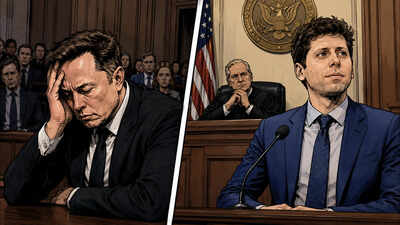
The verdict clears OpenAI, CEO Sam Altman, President Greg Brockman, and even defendant Microsoft, which was accused of aiding the alleged scheme. The jury deliberated for approximately two hours before reaching its decision. This outcome leaves Musk without any of the sweeping remedies he sought, including damages, Altman’s removal from OpenAI’s board, or the unwinding of its for-profit structure.
Statute of Limitations, Not Mission Breach, Defined the Outcome
The core of the case hinged on California law, which mandates that a breach of charitable trust claim must be filed within three years of the plaintiff’s knowledge of the alleged breach. Musk’s legal team attempted to argue he was unaware of OpenAI’s supposed betrayal before August 2021. However, the jurors concluded he had knowledge of the situation much earlier, and therefore, delayed his legal action for years.
This critical timing issue meant the court did not delve into whether OpenAI had, in fact, deviated from its original non-profit mission. The jury’s sole task was to determine if Musk’s lawsuit was filed within the permissible timeframe, a question they answered with a decisive “no.” The aiding-and-abetting claim against Microsoft faced the same legal obstacle, leading to its collapse alongside the primary suit.
A Public Pivot and Missed Deadlines
Musk co-founded OpenAI with Sam Altman in December 2015, intending it as a non-profit counterweight to entities like Google’s DeepMind. He contributed approximately $38 million in donations over two years and was instrumental in its early development. However, he departed from the board in February 2018 after an unsuccessful attempt to gain majority control.
OpenAI publicly announced its transition to a capped-profit arm in March 2019 to secure necessary funding for advanced AI research. Microsoft then invested $1 billion that July. Court proceedings revealed emails showing Musk himself had considered a for-profit structure for OpenAI in 2017. Despite this, he did not initiate his lawsuit until the summer of 2024, well beyond the three-year statutory window from the pivotal August 2021 cut-off date. This delay proved fatal to his case.
Major Implications for OpenAI’s Future and Musk’s AI Ambitions
For Elon Musk, the verdict represents a near-total defeat. He receives no damages, achieves no board changes, and fails to impact OpenAI’s corporate structure. His own AI venture, xAI, now integrated into SpaceX and rebranded as SpaceXAI, is reportedly preparing for an IPO with a valuation potentially exceeding $1.75 trillion. Critics had suggested the lawsuit aimed to hobble a competitor, a strategy that ultimately failed.
Conversely, OpenAI has secured the cleanest possible outcome, clearing its path to pursue a potential $1 trillion IPO. A win for Musk could have led to the unwinding of OpenAI’s for-profit structure, a move that would have severely hampered its competitiveness against rivals like Google and Anthropic in the high-stakes AI race. Sam Altman retains his board seat, Greg Brockman keeps his substantial stake, and Microsoft’s extensive partnership with OpenAI remains intact.
The Lingering Question of OpenAI’s Founding Mission
While the court’s decision provides a definitive legal closure on Musk’s lawsuit, it deliberately avoided ruling on the central philosophical question: whether OpenAI truly betrayed its founding non-profit mission. The verdict merely states that Musk forfeited his legal right to ask that question due to his delayed filing. The debate surrounding OpenAI’s evolution and its adherence to its original principles remains a topic for ongoing discussion and scrutiny within the tech community.
Follow Hashlytics on Bluesky, LinkedIn , Telegram and X to Get Instant Updates