What PrismML Actually Does
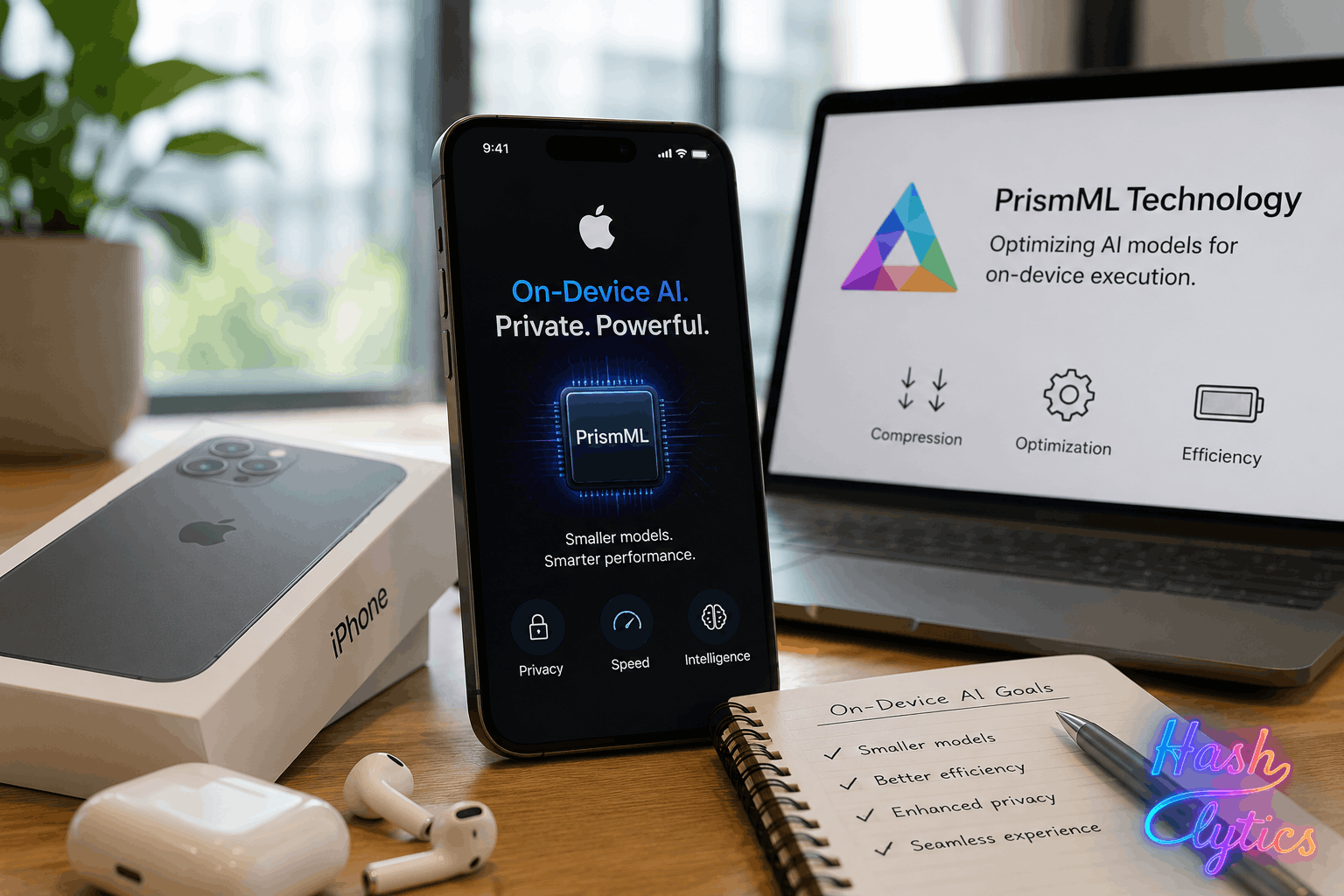
PrismML, backed by Khosla Ventures, says its technology can reduce AI models by up to 15 times less memory. The startup released compressed versions of Alibaba’s Qwen model on Tuesday, shrinking it from roughly 54 GB down to under 4 GB. That compression allowed a 27 billion parameter model to run on iPhone 15 and newer devices.
PrismML CEO Babak Hassibi confirmed to CNBC that Apple and other major companies are evaluating these models. He characterized the discussions as early but moving forward, according to reporting from The Information.
The compression works by simplifying how internal data gets stored. Each value shrinks from 16 bits down to just one or three possible values. This radical reduction cuts the memory needed to store and run the model substantially.
Why Apple Needs This
Apple’s interest makes strategic sense. The company released a public beta of iOS 27 with a major Siri overhaul, signaling that competitive pressure is mounting. Running AI on-device would give Siri three critical advantages.
Speed matters first. Local processing eliminates the latency of sending requests to cloud servers and waiting for responses. Tasks that currently take seconds could happen instantly.
Privacy comes second. Keeping sensitive data on the device aligns perfectly with Apple’s privacy-first brand positioning. Users wouldn’t have to send voice queries or personal information to Apple’s servers.
Reliability is third. On-device AI would let certain features work without an internet connection, a feature cloud-dependent systems simply cannot offer.
Analysts see broader possibilities. Carolina Milanesi at Creative Strategies suggests smaller models could enable demanding on-device features like computational photography, video generation, and health tools using personal data. Horace Dediu at Asymco notes that Apple likely wants to handle the majority of routine Siri interactions on-device, reserving only the most computationally intensive tasks for the cloud.
The Trade-offs: Speed Versus Accuracy
PrismML’s compressed models deliver impressive efficiency gains. They claim to use 10 to 15 times less memory, generate responses six to eight times faster, and consume three to six times less energy than conventional versions.
But there’s a catch. Hassibi acknowledged that compression comes with performance loss. The compressed models typically lose a few percentage points overall, with factual recall suffering more than reasoning, math, and coding capabilities. This means users might get faster answers that aren’t always as accurate.
PrismML is releasing two free compressed versions of its model for everyday devices including iPhones, MacBooks, and Nvidia-powered PCs.
What This Means for the Tech Industry
Efficient on-device AI could ripple across the hardware market. Morgan Stanley estimates Apple’s average DRAM cost per bit could rise roughly 190 percent year-over-year in fiscal 2027 as demand shifts. PrismML’s approach could allow cloud models requiring eight GPUs to run on just one, or enable server-grade models to move onto consumer phones and laptops.
Analyst Gil Luria at D.A. Davidson cautioned that this represents a shift in chip demand from datacenters to devices rather than a reduction overall. He also noted that running AI on individual devices can sometimes be less efficient than using shared datacenter infrastructure.
Google’s recent TurboQuant paper explored similar compression techniques, showing this is becoming a competitive battleground across the industry.
The Real Test Ahead
Tarun Pathak at Counterpoint Research emphasized that real-world performance across millions of queries on thousands of devices will be the ultimate measure of PrismML’s claims. Lab results look impressive, but shipping this at scale on millions of iPhones would be an entirely different challenge.
If Apple moves forward with PrismML technology, users could see noticeably faster and more private AI features within the next year or two. For now, the technology remains in evaluation, but the direction is clear: the next frontier of AI competition happens on your phone, not in the cloud.
Follow Hashlytics on Bluesky, LinkedIn, Telegram and X to Get Instant Updates