+0.67%
-0.30%
-2.44%
-3.88%
-1.19%
+4.51%
The Framework Takes Shape
The new Russian law aims to formally legalize the digital asset sector. On , a session hosted by the Digital Currency Expert Center of the Association of Russian Banks highlighted the scale of work still ahead. While the legal framework represents a starting point, regulators and industry participants acknowledge that critical areas need resolution before the law can be effectively applied.
How Crypto Will Be Taxed
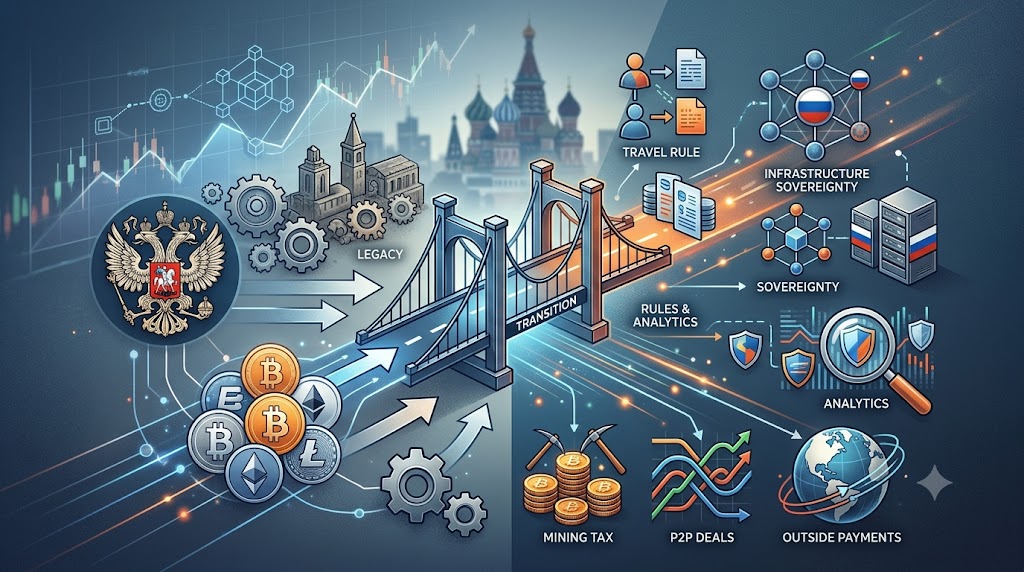
Russia will calculate the tax base for cryptocurrency in rubles. Even asset swaps, if the ruble equivalent rises, can trigger a taxable event. The tax rates vary significantly by taxpayer type and activity:
| Taxpayer Category | Regular Transactions | Industrial Mining |
|---|---|---|
| Individuals and Sole Proprietors | 13-15% | 13-22% |
| Legal Entities | Not specified | 25% |
One significant restriction: losses cannot be carried forward to offset future profits, creating a strict rule for investors. According to Russia’s Ministry of Finance as of , amendments to the Tax Code are expected after the law passes to synchronize regulation and taxation. These amendments anticipate VAT exemptions for digital brokers and exchanges.
Foreign Wallets: Reporting Required, Registration Voluntary
Regarding foreign wallets, mandatory registration will not be required, a concession from the Ministry of Finance. Dmitry Frolov, deputy head of the Ministry of Finance’s financial policy department, confirmed on , that declaring foreign wallets will be voluntary.
However, all transactions conducted via foreign wallets must still be reported to tax authorities. From , Russian platforms will become the primary source for exchange rate quotes used in tax calculations.
Payments Still Prohibited
The law maintains the ban on using digital currency for domestic payments for goods and services. Current amendments do not propose softening this restriction. An exception exists for foreign economic activity, where miners can use digital currency to pay foreign commissions and hedge currency risk.
The Travel Rule Problem: Data Sovereignty vs. International Standards
The FATF Travel Rule presents a critical unresolved issue. This rule mandates transmitting sender and receiver data with digital currency transfers. The problem is significant: existing protocols like TRUST, OpenVASP, and Sygna are Western-controlled. Compliance would mean Russian users’ KYC data flowing to foreign platforms, potentially feeding Western blockchain analytics tools used for sanctions enforcement.
Russia currently lacks a national data-transfer standard compatible with international requirements that also protects domestic personal data. Non-compliance with the Travel Rule could lead to Russian platforms losing access to international liquidity, creating a catch-22 for exchanges.
Infrastructure Gaps Need Closing
Many Russian operators currently rely on remote access to foreign nodes for blockchain transactions. This creates operational vulnerabilities, including the risk of sudden disconnection due to sanctions or geopolitical pressure.
Two major infrastructure needs remain unmet:
- Domestic node infrastructure: A national node network for key blockchains like Bitcoin, Ethereum, and Tron, hosted domestically, is being planned by the Association of Russian Banks but still in planning stages.
- Blockchain analytics: The global market for blockchain analytics and address tagging is dominated by Western companies such as Chainalysis, Elliptic, and Crystal. Their methodologies are opaque to Russian regulators, creating compliance gaps for Russian virtual-asset service providers. No independent, industrial-scale domestic analytics platform exists yet.
What Investor Protections Look Like
The law is expected to pass its second and third readings around , according to Anatoly Aksakov, head of the State Duma’s Financial Market Committee. New investor protections include:
- Exchanges must credit purchased currency only to the buyer’s own wallet
- Digital depositories must suspend large transfers to third parties or abroad for 48 hours
- Non-qualified investors can buy up to 300,000 rubles per year in liquid cryptocurrencies through each intermediary
These protections represent an attempt to balance market access with risk management for retail participants entering Russia’s newly legalized crypto market.
Follow Hashlytics on Bluesky, LinkedIn, Telegram and X to Get Instant Updates