-0.75%
-0.62%
-5.21%
+8.39%
-0.85%
-2.74%
The Historical Parallel
Horsley argues that doubting the value of native tokens like ETH and SOL for RWA infrastructure mirrors a critical market error from the past. He likened this skepticism to the blockchain, not Bitcoin
thesis of earlier years, when critics tried to separate utility from underlying token economics.
This attempt to divorce RWA utility from the base-layer coins is simply the 2026 version of that historical mistake
, Horsley said. In other words, the market has moved into an on-chain versus off-chain phase where native tokens are proving essential to the value proposition.
The Data Backs the Argument
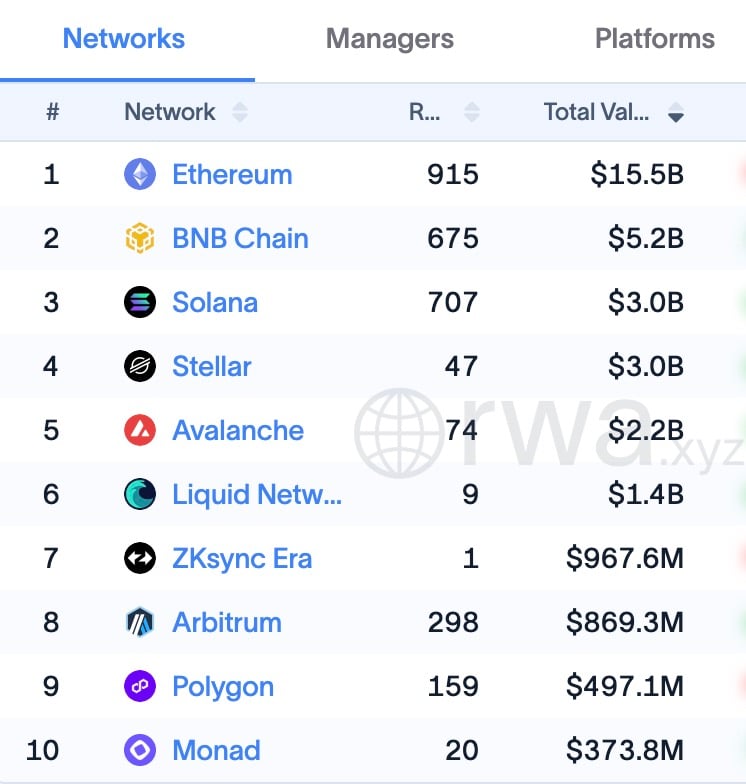
Analytics platform RWA.xyz provides concrete evidence supporting Horsley’s position. Ethereum dominates the RWA infrastructure landscape, hosting $15.5 billion in distributed value across 915 projects. Solana ranks third with $3.0 billion supporting 707 active products.
These native coins serve critical functions. Gas fees for transactions and network security through staking create direct economic linkage between token value and the growth of tokenization infrastructure. The larger the RWA ecosystem becomes, the more valuable securing and transacting on these networks becomes.
Bitwise’s Strategic Angle
Behind Bitwise’s defense lies a strategic commercial interest. The fund has invested in Hyperliquid, a decentralized trading platform experiencing rapid expansion, particularly in RWA derivatives.
| Platform | RWA Derivatives Open Interest | Total Open Interest |
|---|---|---|
| Hyperliquid | $3.6 billion (all-time high) | $11 billion (all-time high) |
| Solana spot market | $3.0 billion | N/A |
Hyperliquid’s RWA derivatives open interest of $3.6 billion now surpasses Solana’s entire spot RWA market. By advocating for the economics of ETH and SOL, Bitwise is simultaneously directing investor attention toward alternative infrastructure solutions where it holds strategic positions.
What’s At Stake
Horsley’s defense reveals a fundamental debate about tokenization infrastructure. The question isn’t whether real-world assets should move on-chain. Nearly every major financial institution now agrees they should. The real question is which blockchains will host the majority of this value and earn the corresponding economic benefits through transaction fees and network security premiums.
For Ethereum and Solana, the case is strengthening. As more trillions in tokenized value flow onto these networks, their native tokens become increasingly valuable. For skeptics who want tokenization without accepting the token economics, Horsley’s message is clear: that worked once as a narrative. It won’t work twice.
Follow Hashlytics on Bluesky, LinkedIn, Telegram, and X to Get Instant Updates