-1.28%
-2.02%
+1.32%
-2.44%
+1.17%
-3.05%
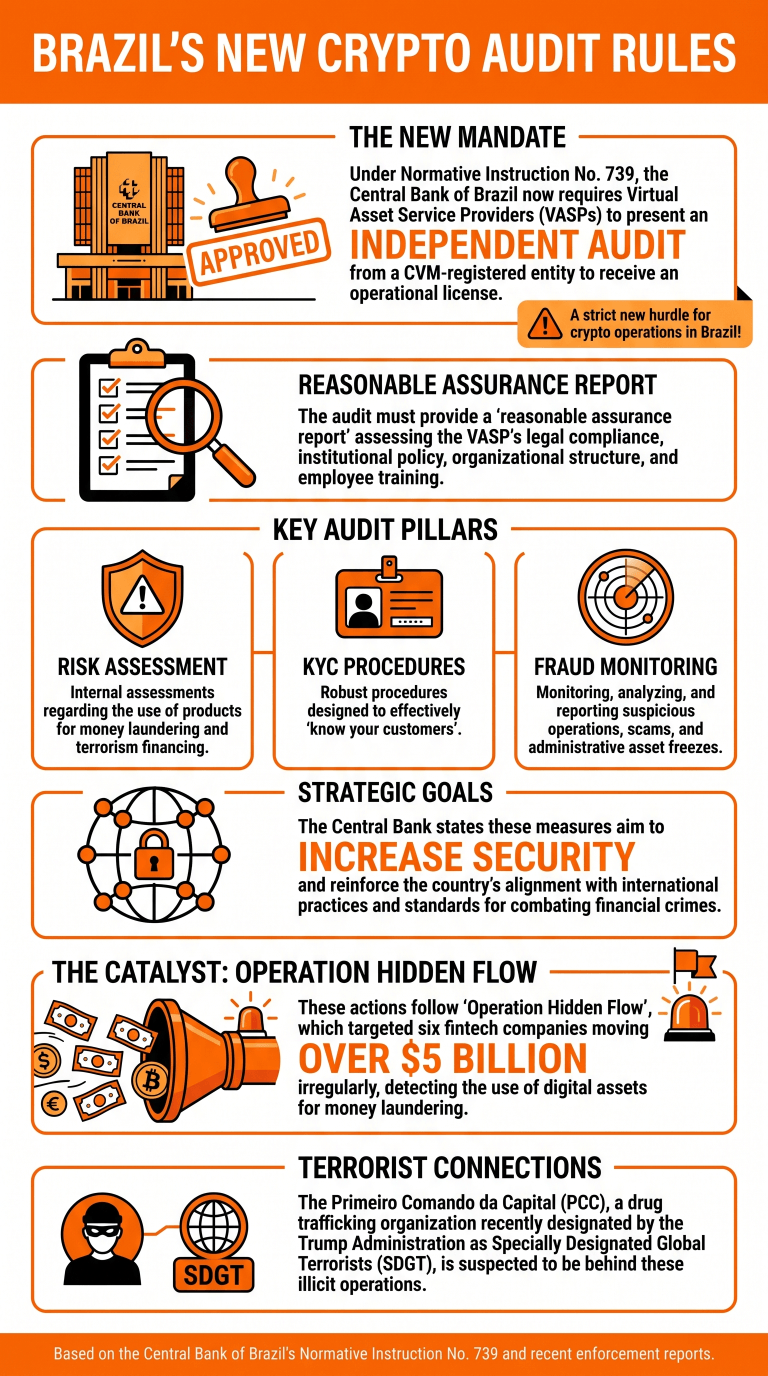
Brazil’s Central Bank has significantly tightened its regulatory grip on virtual asset service providers (VASPs), mandating independent audits for all entities seeking operational licenses. The move aims to enhance security and transparency within the nation’s burgeoning crypto sector, aligning Brazil with international standards for combating financial crimes.
New Audit Mandate Takes Effect
Under the newly issued Normative Instruction No. 739, published Friday, VASPs must now undergo a comprehensive audit by a third-party entity registered with the Brazilian Securities and Exchange Commission (CVM). This requirement is a prerequisite for obtaining authorization to operate in Brazil.
The reasonable assurance reports
from these audits must provide detailed assessments of a VASP‘s legal compliance across multiple critical operational areas.
What Auditors Will Scrutinize
The mandated audits will examine several key aspects to ensure robust defenses against illicit activities:
- Legal compliance: Institutional policy, organizational structure, and employee training
- Risk assessment: Potential use of company products and services for money laundering and terrorism financing
- Know Your Customer (KYC) procedures: Verification that obligations are effectively met
- Transaction monitoring: Capability to monitor, select, analyze, and report suspected money laundering, terrorism financing, and weapons of mass destruction financing
- Fraud detection: Monitoring and analysis of evidence related to fraud and scam attempts
- Asset freeze protocols: Administrative procedures for freezing assets when required
Context: Operation Hidden Flow
This regulatory escalation follows Operation Hidden Flow, a major enforcement action that exposed six fintech companies involved in moving over $5 billion irregularly through digital assets for money laundering purposes. Investigators suspect the Primeiro Comando da Capital, a major drug trafficking organization, orchestrated these operations.
The Central Bank of Brazil stated that these measures are designed to increase the security of decisions in authorization processes, while reinforcing the country’s alignment with international practices and standards for combating these crimes
. The bank emphasized that independent verification contributes significantly to greater transparency and reliability in sector controls.
Impact on the Crypto Market
The new audit requirement undoubtedly makes the licensing process more challenging for new entrants seeking to operate in Brazil. However, it also signals a clear expectation for operational integrity and compliance from all VASPs.
This move is poised to reshape the landscape of crypto services in Brazil by prioritizing security and consumer protection against financial illicit activities. For compliant operators already in the market, the stricter standards may create a competitive advantage by establishing clearer trust and regulatory certainty.
Follow Hashlytics on Bluesky, LinkedIn, Telegram and X to Get Instant Updates