
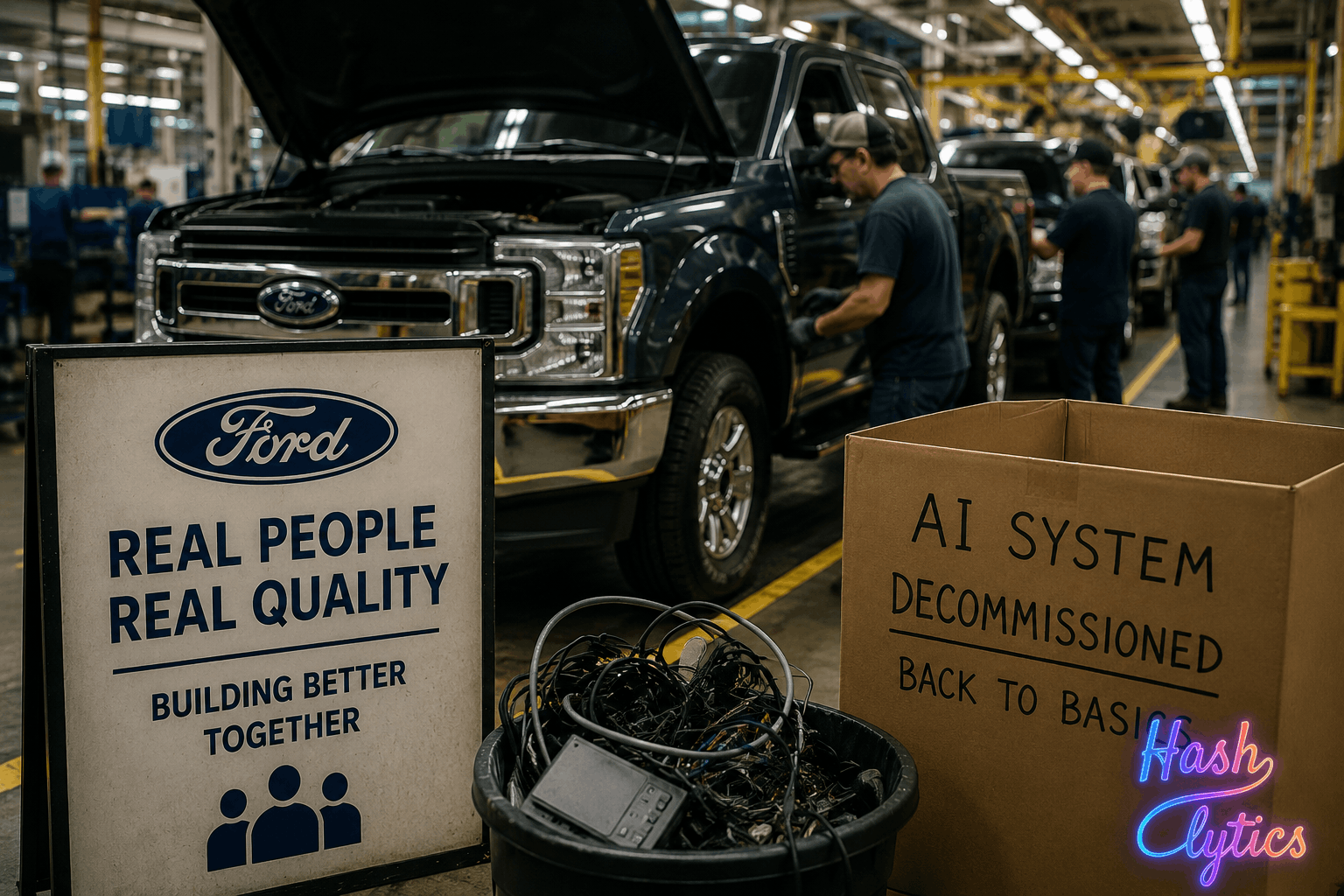
What Actually Happened at Ford
Ford shed roughly 5,300 salaried positions since its 2020 employment peak, part of a wider contraction that eliminated more than 20,000 white-collar jobs across Detroit’s automakers. The company leaned progressively harder on automated inspection systems to compensate. COO Kumar Galhotra told journalists the company had been “relying more and more on automated quality systems and not getting the desired results.” VP of vehicle hardware engineering Charles Poon went further: “Mistakenly we thought that by just introducing artificial intelligence and ingesting the design requirements that we had” it would work.
It did not. The problem was not that the AI was fundamentally broken, but that experienced workers left before they could transfer their institutional knowledge into the systems meant to replace them. Without decades of engineering judgment encoded in the training data, Ford’s automated tools amplified weak inputs rather than catching design flaws.
The rehired engineers were tasked with three things: mentoring junior staff, rebuilding the data pipelines feeding Ford’s AI training, and refining the automated systems they were originally brought in to replace. The result was Ford topping the JD Power 2026 U.S. Initial Quality Study for the first time since 2010, with seven of its top ten models ranking in the top three of their segments. CEO Jim Farley said the changes contributed to “hundreds and hundreds of millions of dollars of a tailwind for Ford on cost” through lower warranty and recall bills.
The Irony Nobody Is Addressing
Ford CEO Jim Farley publicly predicted that AI “is going to replace literally half of all white-collar workers in the US.” His own company’s quality crisis is the most visible counter-argument to that thesis in American manufacturing right now. Ford remains the most recalled automaker in the US, issuing 51 recalls in 2026 covering more than 11 million vehicles, more than double the next-closest manufacturer, though executives attribute this to the earlier automation-heavy period rather than current operations.
Anthropic has pledged $200 million to study AI’s impact on jobs, and its co-founder has urged controls on AI progression. Ford’s case gives that research a concrete starting point: the transition cost is not just the workers displaced, but the institutional knowledge that disappears with them and cannot be recovered from job postings or training datasets alone. OpenAI, Anthropic, Amazon, and Microsoft this week backed RAISE US, a $500 million nonprofit to retrain American workers for the AI economy. Ford’s experience suggests the harder problem is not retraining but knowing which workers you cannot afford to lose in the first place.
Follow us on Bluesky, LinkedIn, X, and Telegram to Get Instant Updates