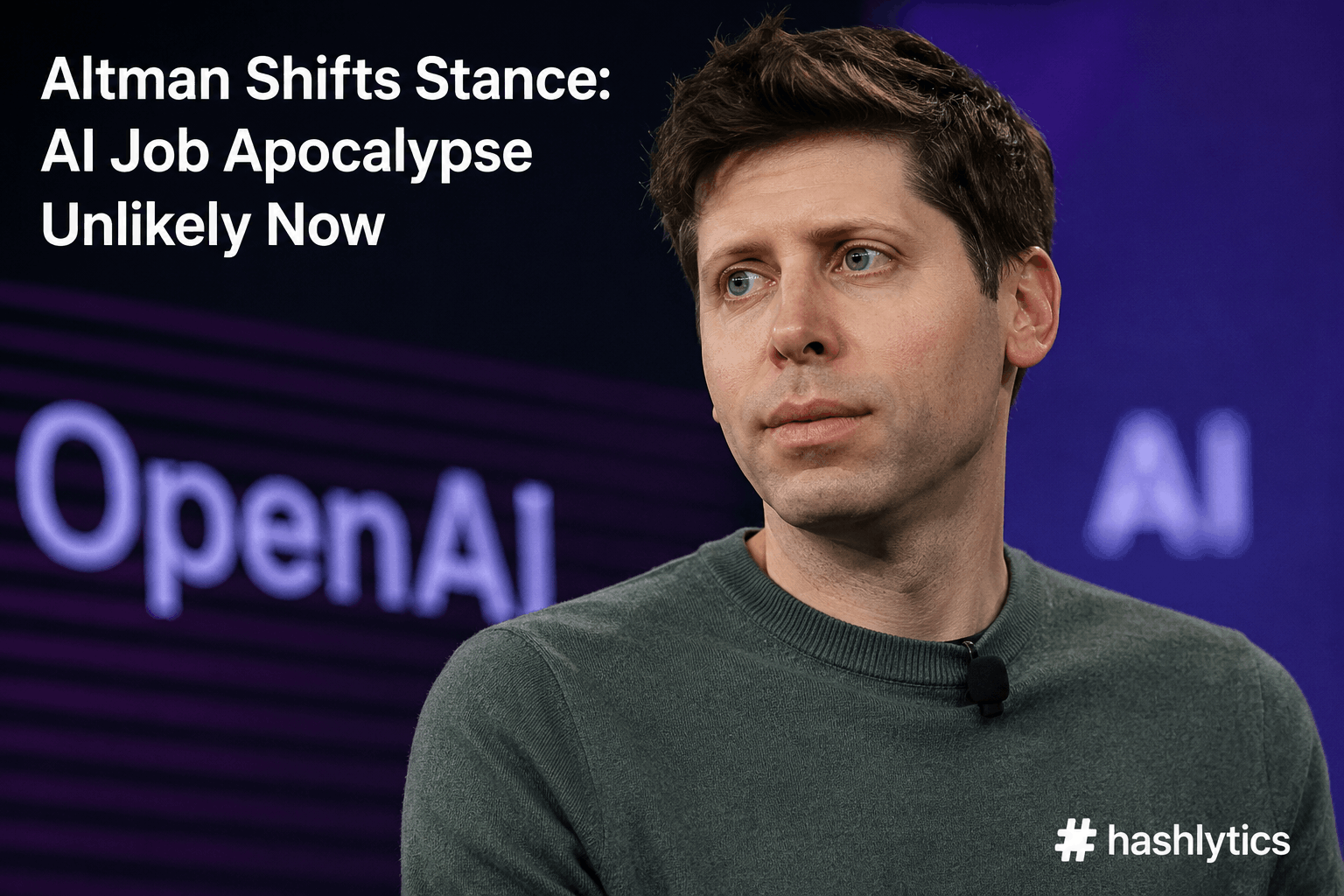
probably replace most of the jobs people do todayand that entire job categories would be
totally, totally gone. He now expresses relief that those dire predictions have not yet materialized.
Altman’s Shift at Commonwealth Bank Conference
During a virtual interview at a Commonwealth Bank of Australia (CBA) conference in Sydney, Altman stated, I don’t think we’re going to have the kind of jobs apocalypse that some of the companies in our space advocate or talk about.
He admitted his intuitions were off
regarding the impact on entry-level white-collar jobs. Altman now believes the human part
of employment, particularly the desire for human interaction at work, cannot be easily replaced by AI.
AI Industry Navigates High Costs and Slow Adoption
Altman’s revised perspective comes as the AI industry faces a pivotal moment. Major AI companies, including OpenAI, SpaceX, and Anthropic, are preparing for public offerings or significant funding rounds. OpenAI, for instance, aims to reach $280 billion in revenue by 2030, while SpaceX targets a $1.5 trillion valuation. Despite these ambitious targets, some companies are struggling to justify the escalating costs of AI adoption. Uber’s President and COO, Andrew Macdonald, noted the increasing difficulty in rationalizing AI expenses, and Microsoft has reportedly begun canceling Anthropic’s Claude licenses for its engineers due to high costs. Nvidia’s Bryan Catanzaro also suggested that AI use might cost more than human labor for some teams.
Contrasting Views on AI’s Labor Market Impact
While Altman has softened his stance, other industry leaders maintain a more cautious view. Dario Amodei, CEO of Anthropic, predicted last year that up to half of all entry-level white-collar jobs could disappear within five years, leading to unemployment skyrocketing to 10-20%. Booking Holdings CEO Glenn Fogel similarly observed that AI is eliminating the lowest rung on the ladder
in customer service roles. Indeed, thousands of jobs have been cut this year, with companies like Meta, Intuit, Amazon, and Alphabet citing a strategic shift towards AI for efficiency. Research by Challenger, Gray & Christmas indicates nearly 50,000 job cuts through April have been attributed to AI.
Public Opinion and the Narrative Shift
Peter Wildeford, Head of Policy at the AI Policy Network, suggests that public opinion might be influencing the narrative. He noted that Americans generally feel negative about AI’s impact. Wildeford speculates that the industry, and Altman in particular, may be attempting to shift the narrative to emphasize job creation rather than displacement. Economists remain divided on the extent of AI’s impact, with a recent Brookings report highlighting that rapid AI advancements are not automatically translating into widespread economic gains or meaningful adoption.
The debate over AI’s long-term effects on the job market continues, with current data suggesting a slower adoption rate and less immediate disruption than some early predictions. While technological capabilities are rapidly advancing, the economic and social integration of AI is proving to be a more complex, gradual process. The Yale Budget Lab’s May study found no meaningful change in unemployment for workers in jobs with high AI exposure through March 2026, indicating that a widespread jobs apocalypse
remains speculative.
Follow Hashlytics on Bluesky, LinkedIn , Telegram and X to Get Instant Updates