What Google Announced
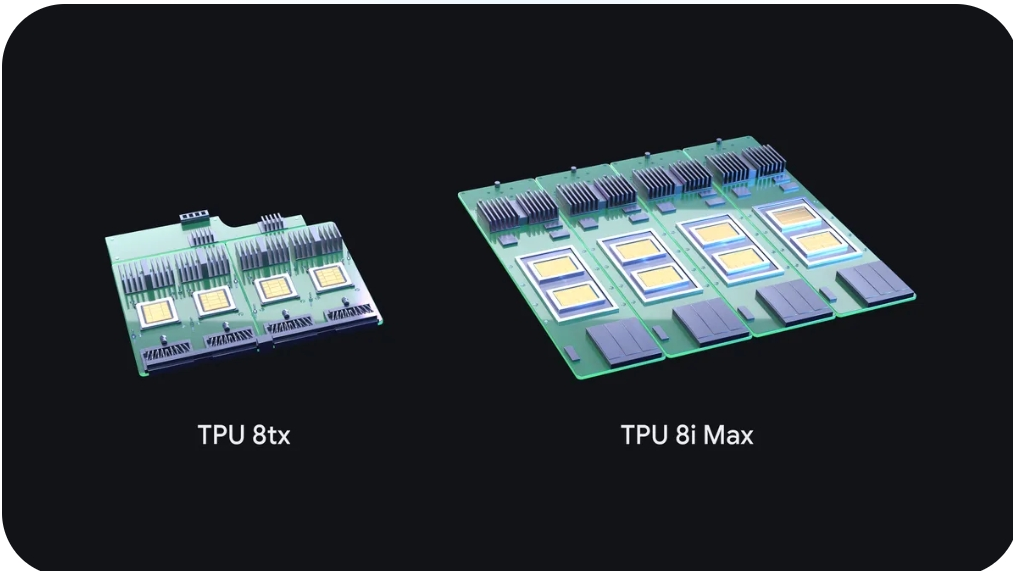
- TPU 8i Max: two TPU 8i chips on one package, with double the compute, SRAM and memory bandwidth, and twice the silicon in the same rack space. Google pitches it at agents working across large codebases or hours of video
- TPU 8tx: built on 8t silicon with AMD EPYC hosts, it protects data and model weights while in use, aimed at regulated enterprises and governments. Google claims up to 2x lower latency than the 8t and a “near-zero performance penalty” for security
- Software: TorchTPU runs PyTorch and Hugging Face models natively. Open-source TPU Sync is claimed to cut KV transfer latency by over 90%, and Agent Compute Engine suspends idle agent sessions to save compute
What Google Has Not Said
The post gives no pricing, regions or availability dates for either system, no absolute memory or context figures, and no named customers beyond “nearly 100” unnamed ones. Benchmark claims cite SemiAnalysis but publish no numbers, so every figure is Google’s own. The executive post promises zero code rewrites for PyTorch models, while the blog says only that they run natively, and no independent test has confirmed either. The 8tx description also omits attestation and key management, the first things security teams ask about.
My Take
The idea that Google is celebrating while Nvidia sinks needs care. Nvidia fell 9.26% on November 5, before the board statement and Huang’s apology on November 8, and the coverage we found blamed a chip-sector slide and midterm-linked fears about AI policy, not the Huang story. The stock recovered part of that loss the next day. The probe is a governance risk, and the board says it sees no sign that national security or company secrets were compromised.
The sharper rivalry is software. TorchTPU targets the CUDA lock-in that keeps developers on Nvidia GPUs, and Google’s test is whether independent benchmarks back its claims. It says its vLLM and TorchTPU stack leads on price-performance, again without numbers. Watch two dates: Nvidia reports earnings on November 17, and House chairs want Huang briefed on November 18.
For Nigeria and the wider region, confidential inference is the part to watch. Banks and health firms handling personal data under the Nigeria Data Protection Act 2023, and EU and UK firms under GDPR, are the obvious buyers of in-use encryption. Google named no regions, so African availability is unknown.
Follow us on Bluesky, LinkedIn, X, and Telegram to Get Instant Updates