+0.24%
-0.17%
-2.00%
+3.72%
+0.88%
-0.88%
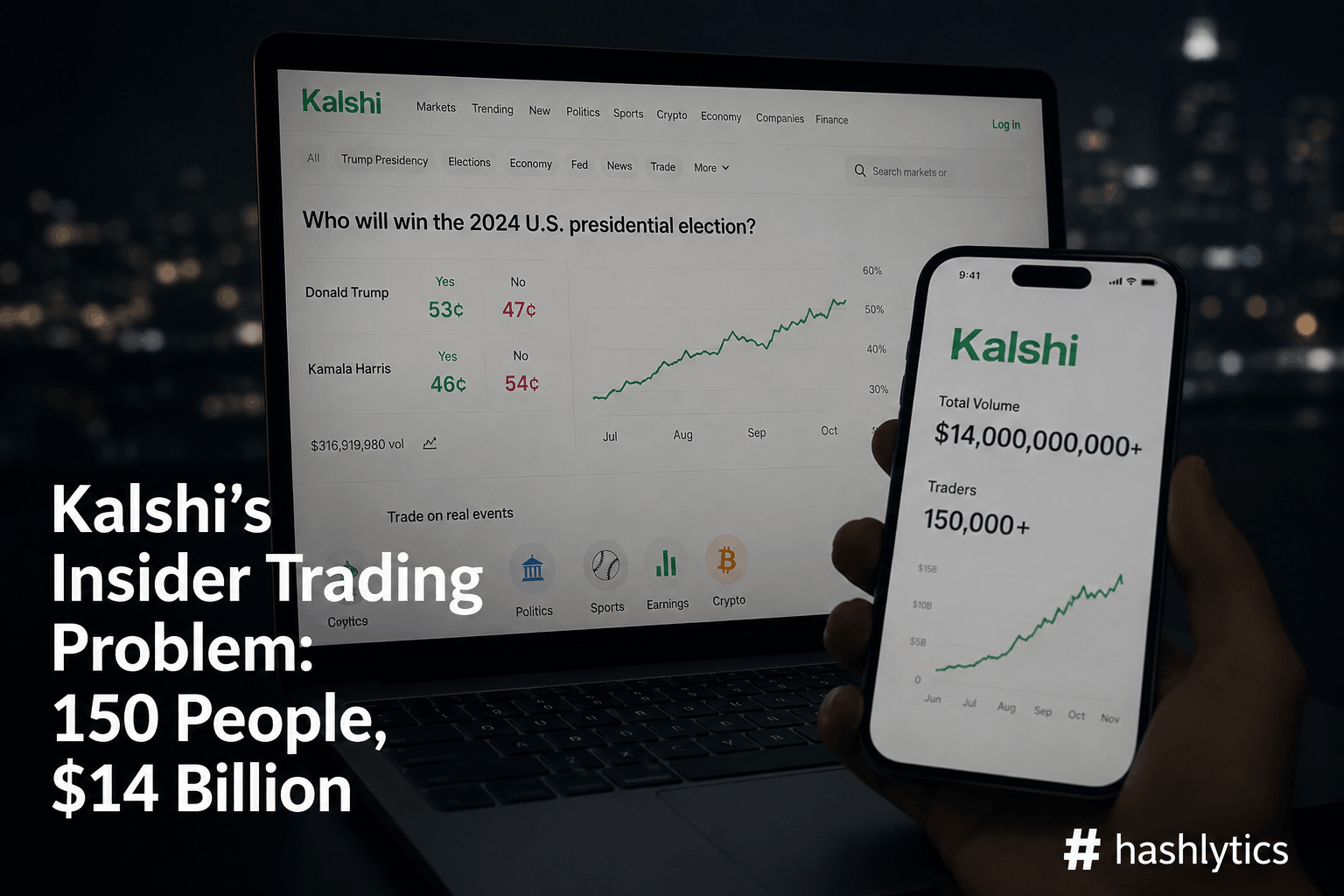
Kalshi co-founder Luana Lopes Lara told the Wall Street Journal at its Future of Everything event that her company operates 200 active insider trading investigations with a staff of 150 people overseeing $14 billion in annual trading volume. The admission, delivered during a panel on enforcement capabilities, reveals a structural mismatch between surveillance resources and market scale that academic research suggests makes comprehensive insider trading detection functionally impossible, a problem Kalshi addresses not through technical solutions but through preemptive bans, post-trade investigations lasting up to a year, and publicized enforcement actions that may create deterrence theater while sophisticated violators evade detection.
The Enforcement Numbers Don’t Add Up
Kalshi opened 200 insider trading investigations in the past year and froze flagged accounts across that investigative pipeline. Over a dozen became active enforcement cases. The platform has publicly disclosed enforcement actions including a MrBeast editor fined $20,000 and suspended two years for trading $4,000 on YouTube streaming markets, three congressional candidates suspended five years for betting on their own races (fines ranging from $539 to $6,229), and a California gubernatorial candidate banned for wagering $200 on himself and posting about it on social media.
Compare those publicized cases against market fundamentals. Kalshi processed $14 billion in trading volume in 2025. With 150 total employees, not all focused on surveillance, the platform maintains what Lopes Lara described as “layers” of protection: legal prohibitions against material non-public information, exchange-specific trading prohibitions even without legal requirements, and pre-trade screening that blocks identified insiders before they enter markets.
The arithmetic problem is obvious. If 200 investigations generated a dozen enforcement actions, that’s a 6% conversion rate from suspicion to proven violation. Those investigations span a year on average according to Lopes Lara, requiring information submission, paperwork reviews, and social network analysis to identify friends and family connections. A staff of 150 handling year-long investigations across $14 billion in volume means resource allocation decisions favoring deterrence visibility over comprehensive surveillance.
Robert DeNault, Kalshi’s head of enforcement, emphasized that “regardless of the size of a trade, political candidates who can influence a market based on whether they stay in or out of a race violate our rules.” The company’s public enforcement actions demonstrate this principle—Kalshi prosecuted Matt Klein’s $50 bet on his own Minnesota congressional primary and Ezekiel Enriquez’s sub-$100 wager on his Texas race alongside larger violations. But the emphasis on small-dollar political cases creates selection bias favoring easily identifiable, high-visibility violations over sophisticated insider trading that would require deeper technical analysis to uncover.
Why Insider Trading Detection Is Structurally Impossible
Academic research on securities markets demonstrates why insider trading is nearly impossible to stop even with dedicated regulatory agencies, subpoena power, and unlimited budgets. The SEC employs over 4,000 people with statutory authority to compel testimony and access to FINRA’s Market Regulation Surveillance System monitoring all U.S. equity markets. Despite those resources, insider trading conviction rates remain below 1% of estimated violations, according to research published in the Journal of Financial Economics.
The detection challenge stems from behavioral mimicry. Sophisticated insiders trade in patterns indistinguishable from informed speculation by outsiders conducting legitimate research. A politician’s aide betting on legislation they helped draft looks identical to a policy analyst who correctly predicted the same outcome through public signals. Distinguishing material non-public information from excellent research requires proving the trader possessed specific knowledge unavailable to the public—evidence that emerges only through testimony, communications records, or admissions.
Kalshi’s approach acknowledges this limitation by implementing preemptive bans. Politicians cannot trade on their own races. Athletes cannot bet on their own leagues. Company employees face restrictions on markets involving their employers. This shifts the enforcement burden from detecting sophisticated violations to identifying when banned individuals circumvent screening systems—a technically simpler but still resource-intensive task.
The MrBeast editor case illustrates both the strength and weakness of this model. Kalshi identified that the trader worked for the YouTube creator and likely had access to material non-public information about streaming content. The platform froze the account, preventing profit withdrawal, then conducted an investigation that resulted in a $20,000 fine and two-year suspension. Success depended on linking the trading account to the employment relationship—feasible when the insider uses their real identity and employment is publicly documented, far harder when sophisticated violators use intermediaries, offshore accounts, or anonymizing techniques.
The Polymarket Comparison and Competitive Pressure
Kalshi’s enforcement transparency operates against competitive pressure from Polymarket, which partnered with Chainalysis for on-chain trade monitoring to detect suspicious patterns in blockchain-based prediction markets. The April 2026 DOJ indictment of U.S. Army service member Gannon Ken Van Dyke for using classified intelligence to bet $33,000 on Polymarket that the Maduro raid would succeed—cashing out $400,000 profit—demonstrates the scale of insider trading both platforms face.
An anonymous Polymarket trader netted roughly $300,000 correctly betting on four specific Biden pardons issued in the final hours of his administration. These high-profile cases create regulatory pressure that both platforms navigate through visible enforcement while the structural detection problem remains unsolved. The CFTC filed its first-ever insider trading complaint concerning event contracts against Van Dyke on April 23, 2026, with the Southern District of New York simultaneously unsealing criminal charges—a combined civil and criminal enforcement posture signaling how seriously regulators now treat prediction market integrity.
CFTC Chairman Michael Selig stated in April congressional testimony that the agency maintains “zero tolerance” for insider trading in prediction markets. CFTC Director David Miller emphasized March 31 that the Commission expects designated contract markets to serve as “first line of defense” against manipulation, with federal enforcement activating when exchange-level surveillance proves insufficient. That regulatory framework places detection responsibility on platforms like Kalshi despite resource constraints that make comprehensive surveillance mathematically impossible.
The Congressional Response and Regulatory Future
At least seven bills targeting prediction market oversight have been introduced since January 2026. The PREDICT Act (Reps. Nikki Budzinski and Adrian Smith, March 25) would ban members of Congress, the president, vice president, senior staff, and their families from trading on political events or policy decisions, with civil penalties of 10% of transaction value plus disgorgement of profits. Rep. Greg Casar’s bill would prohibit prediction market trading on non-financial government actions, terrorism, assassination, war, and any event where individuals can control outcomes.
Sen. Richard Blumenthal’s Prediction Markets Security and Integrity Act proposes comprehensive consumer protections including age verification at 21, restrictions on AI targeting of bettors, and language reversing the Trump administration’s assertion of CFTC jurisdiction—effectively opening platforms to state-level gambling laws. Rep. Blake Moore stated in his bipartisan Event Contract Enforcement Act announcement that “under-regulated prediction markets have exposed America to needless public safety and national security risks.”
About 40 states argue in court that prediction platforms offer products nearly identical to gambling and must comply with state gaming laws. Arizona filed criminal charges against Kalshi for allegedly operating an unlicensed casino and violating state election betting bans. Connecticut issued stop orders against Kalshi alongside Robinhood and Crypto.com. A federal judge recently halted Arizona’s prosecution, but the state-level regulatory conflict remains unresolved.
Kalshi’s enforcement transparency serves a strategic function in this environment. Publicizing small-dollar political candidate violations demonstrates active surveillance to federal regulators and state attorneys general while the company argues for self-regulation over statutory prohibitions. The enforcement actions provide evidence that Kalshi polices bad actors, even if the underlying detection capabilities cannot scale to comprehensive market surveillance.
The Insider Definition Problem Lopes Lara Won’t Answer
When pressed by WSJ’s Amol Sharma on how Kalshi defines “insider” across different markets, Lopes Lara acknowledged “this is a very hard problem” before pivoting to process descriptions. She explained that the platform identifies where information would probably be shared and tries to ban all potential recipients. For markets like “Will Kash Patel be out by X date,” that would include White House staff, Office of Management and Budget employees, and anyone with access to relevant decision-making.
The non-answer reveals the impossibility of comprehensive insider identification. In the Patel example, who qualifies as an insider? Direct reports obviously. Senior administration officials clearly. But what about a scheduler who sees unexpected meeting cancellations? A cafeteria worker who overhears conversations? A family member told in confidence? The information diffusion problem makes preemptive bans unworkable for markets where insider status isn’t binary (politician vs non-politician) but exists on a spectrum of access and likelihood.
Kalshi’s surveillance approach relies on social network analysis once suspicious trades are flagged—investigating friends, family, and professional connections to determine information flow. But that’s reactive detection after violations occur, not proactive prevention. For sophisticated insiders understanding this methodology, the countermeasure is obvious: use intermediaries with no publicly documented connection to the information source. A White House aide with non-public information about Patel’s status tells a college roommate who hasn’t worked in politics and has no discoverable relationship to the administration. That roommate trades. Kalshi’s social circle investigation finds no links because the connection exists offline in text messages and phone calls the platform cannot access.
What the Numbers Actually Reveal
Kalshi’s 200 investigations, dozen enforcement actions, and $14 billion trading volume tell a story about regulatory theater more than comprehensive surveillance. The platform can identify obvious violations—politicians betting on themselves, employees of public figures trading on employer-related markets, individuals posting about their violations on social media. That enforcement creates visible deterrence for the least sophisticated potential violators.
What Kalshi cannot do with 150 employees is detect sophisticated insider trading by individuals who understand surveillance limitations and structure violations accordingly. The selection bias in publicized cases—small-dollar political bets, MrBeast editor using his real employment, California candidate posting on X about his self-bet—suggests enforcement targets low-hanging fruit while sophisticated actors remain undetected.
The market manipulation comparison is instructive. Cryptocurrency exchanges face similar challenges detecting manipulation when founders and insiders move hundreds of millions in assets. Traditional markets experience manipulation despite extensive regulatory oversight. The difference is that securities regulators don’t claim 150 employees can police $14 billion in volume—they acknowledge detection limitations and focus resources on the most egregious, highest-impact violations.
Kalshi’s public posture suggests comprehensive enforcement while the operational reality requires triage. Preemptive bans address obvious insider categories. Post-trade surveillance flags statistically anomalous patterns. Year-long investigations pursue cases where evidence trails exist. But the vast middle ground—sophisticated insiders trading through intermediaries, using anonymizing techniques, or exploiting information categories Kalshi hasn’t defined as requiring bans—likely evades detection entirely.
The Real Question Isn’t Whether Kalshi Can Stop Insider Trading
It’s whether prediction markets can operate at scale without becoming systematically compromised by undetectable insider trading, and whether the value they provide as information aggregation mechanisms justifies accepting that structural vulnerability. Robin Hanson, the economist who developed prediction market theory, argued in April 2026 Fortune coverage that insider trading is the point—insiders with knowledge trade, moving prices toward truth faster than public information alone would.
That theoretical defense conflicts with legal reality. The CFTC, DOJ, and state regulators treat insider trading in prediction markets as criminal conduct. Platforms must enforce against it to maintain regulatory licenses. The contradiction creates an enforcement regime where platforms like Kalshi publicize catching obvious violations while acknowledging privately that comprehensive detection is impossible.
Lopes Lara’s WSJ admission that Kalshi operates 200 investigations with 150 employees overseeing $14 billion in volume quantifies that impossibility. The platform can identify candidates betting on themselves. It can investigate MrBeast employees trading on YouTube content. It can ban politicians from their own races. What it cannot do is detect when a White House staffer’s cousin in Ohio bets $50,000 on Patel’s departure date using information shared at Thanksgiving dinner. The surveillance infrastructure doesn’t scale to that level of social network analysis, and the resource constraints don’t support year-long investigations into every statistically anomalous trade.
The enforcement actions Kalshi publicizes demonstrate capability within narrow categories while the broader market likely contains systematic insider trading that remains undetected because detection is structurally infeasible. That’s not Kalshi’s fault—it’s the mathematical reality of surveilling decentralized information networks with finite resources. The question is whether regulators and users understand that limitation or believe the enforcement theater represents comprehensive protection. The $14 billion in volume suggests users either don’t care or accept insider trading as inherent to prediction markets. Regulators appear less comfortable with that trade-off, hence the seven congressional bills targeting the industry.
Whether Kalshi’s self-regulation proves sufficient to prevent statutory prohibitions depends less on enforcement effectiveness—which structural constraints limit—and more on whether high-profile violations like Van Dyke’s $400,000 Maduro trade become frequent enough to force congressional intervention. For now, Kalshi’s strategy appears to be publicizing small-dollar political cases to demonstrate active surveillance while hoping sophisticated insiders remain invisible enough to avoid triggering regulatory crackdowns. That’s probably the best outcome the resource constraints allow, even if it’s far from the comprehensive enforcement the company’s marketing suggests.
Follow us on Bluesky, LinkedIn, X, and Telegram to Get Instant Updates