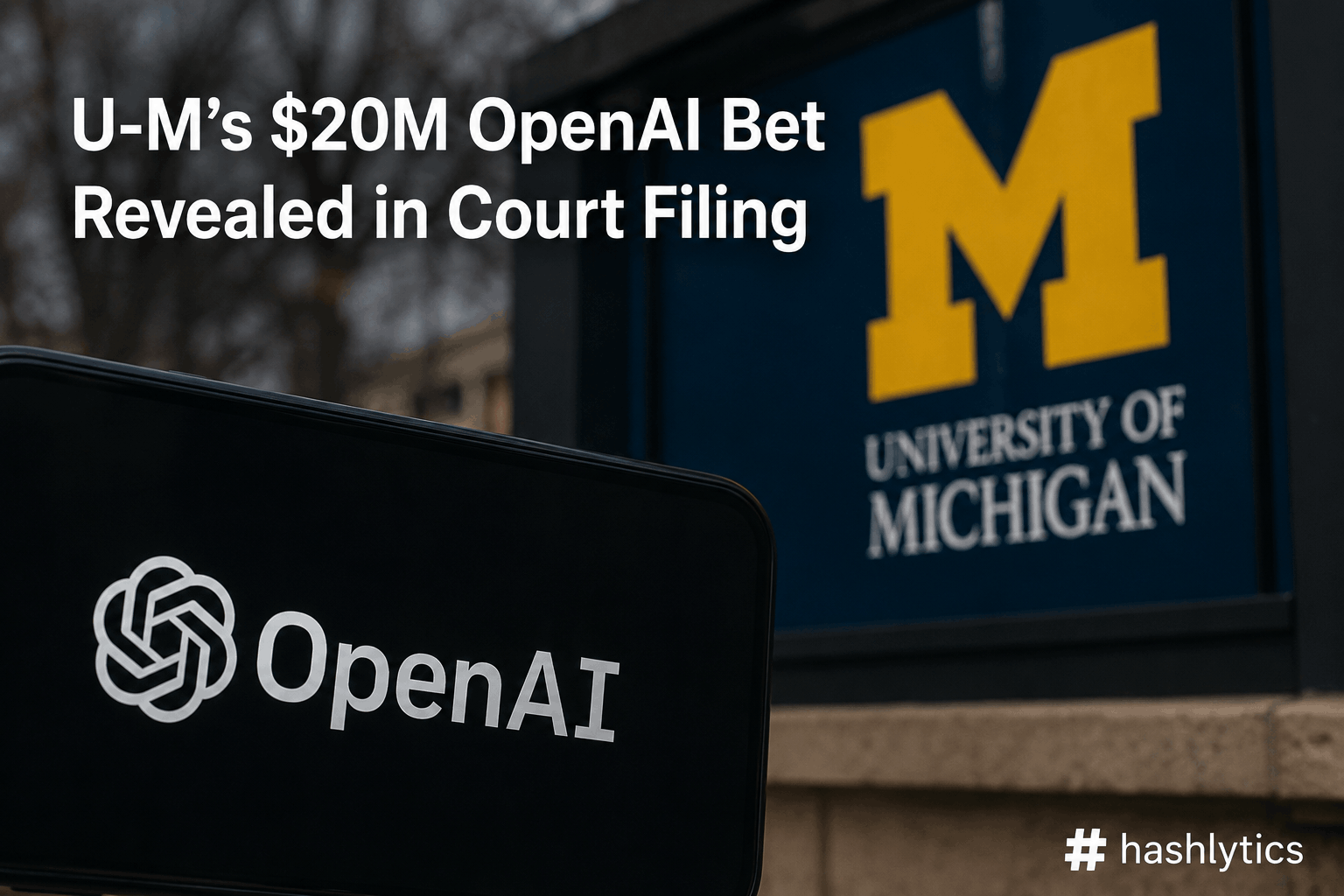
University of Michigan’s $20 Million OpenAI Investment Comes to Light
The investment by the Regents of the University of Michigan was publicly revealed in a 91-page document titled “Schedule A, Member Information,” dated January 23, 2023. This filing surfaced as part of the high-profile legal battle between Elon Musk and OpenAI CEO Sam Altman. Entrepreneur Ben Casnocha first highlighted the document on X, with Business Insider subsequently reporting the details.
While the exact timing of the university’s investment remains undisclosed, the filing suggests it occurred early in OpenAI’s trajectory, predating the company’s exponential growth and multibillion-dollar investments from entities like Microsoft Corp. Other early investors listed in the document include The Aphorism Foundation, linked to LinkedIn founder Reid Hoffman, with $50 million, a trust tied to Gmail creator Paul Buchheit investing $3 million, and technology startup accelerator Y Combinator contributing $10 million.
OpenAI’s Evolving Corporate Structure and Uncertain Returns
The implications of the filing for the university’s investment, including how and when U-M might realize its gains, are currently unclear. OpenAI, founded in 2015, initially operated with a unique limited liability company structure. This allowed outside investors to inject capital while imposing limits on potential returns, as explained by Ann Lipton, a professor of law at the University of Colorado Law School.
According to Lipton, this structure aimed to balance capital raising with maintaining control under a nonprofit entity dedicated to the company’s broader mission. OpenAI has since moved toward a more traditional corporate structure, which could simplify the valuation of ownership stakes if the company pursues a public offering. However, the nonprofit still retains governance control. The company is now valued at over $850 billion.
Lipton suggested that the “target redemption amount” in the filing likely functioned as a cap on returns under the earlier structure, with no guarantee that investors would actually achieve that maximum. She added that under the current structure, U-M’s potential returns would be entirely dependent on the market price of the stock. The ongoing court case, where Elon Musk is advocating for OpenAI to revert to its nonprofit roots, further complicates the outlook.
Endowment Strategy and Long-Term University Funding
As of June 30, 2025, the University of Michigan’s endowment stood at $21.2 billion, making it one of the nation’s largest university endowments. It comprises approximately 13,500 separate funds. Robert Kelchen, a professor of higher education at the University of Tennessee, notes that large university endowments frequently diversify investments across various assets, including venture capital and private equity.
Kelchen highlighted that the unusual aspect of the OpenAI investment is the company’s rapid growth. He explained that large endowments can absorb risks associated with early-stage investments due to their scale and diversification. A substantial gain from this investment would not translate into immediate billions for the university to spend. Instead, it would likely augment the endowment’s overall size, gradually increasing the annual distribution available for university operations, scholarships, research, and other priorities, given U-M’s 4.5% distribution rate.
Future Gains Hinged on OpenAI’s Market Path
The University of Michigan’s $20 million investment in OpenAI, with its potential for a $2 billion redemption, underscores the high-stakes world of venture capital for institutional investors. The ultimate outcome for U-M’s stake will depend heavily on OpenAI’s future corporate direction, including any potential initial public offering, and the resolution of its current legal challenges.
Follow Hashlytics on Bluesky, LinkedIn , Telegram and X to Get Instant Updates