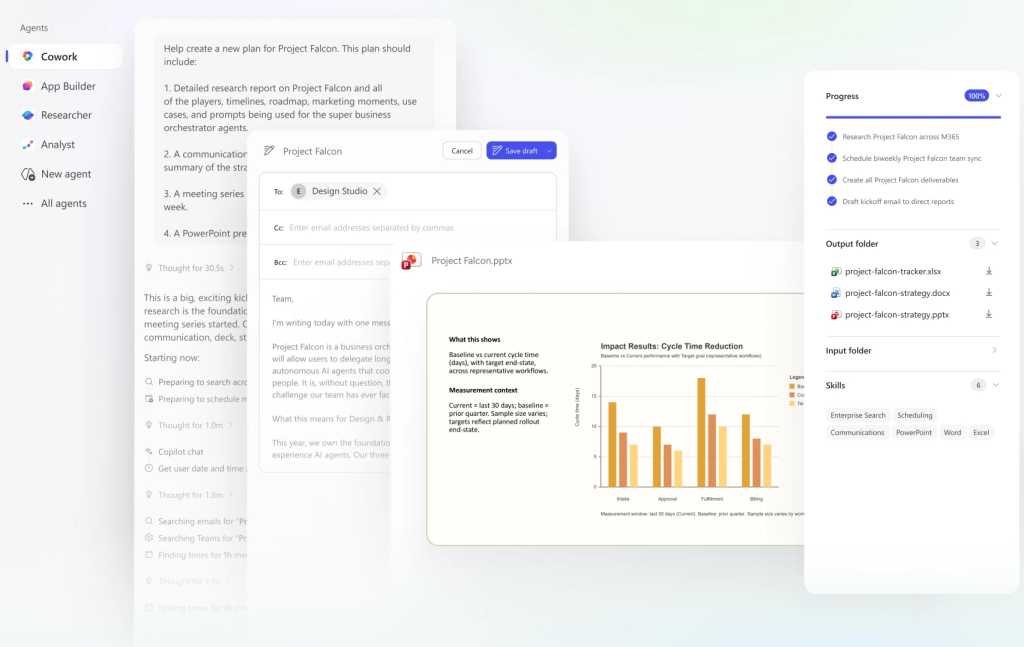
How Copilot Cowork Works
First unveiled in March, Copilot Cowork operates as an AI agent within Microsoft’s cloud environment rather than on local devices. This differs from competitors like Anthropic’s Claude Cowork, which can directly interact with a user’s local files and applications.
The key advantage is that Copilot Cowork processes sensitive business documents and data exclusively within the customer’s Microsoft 365 tenant, providing an additional layer of data security for enterprise environments.
Pricing Breakdown
The new pricing model layers usage-based billing on top of existing Microsoft 365 Copilot licenses. Enterprise customers typically pay $30 per user monthly for Microsoft 365 Copilot, while Business users pay $20 monthly.
Usage costs are calculated from four primary components: model use, context retrieval, tool calls, and runtime. Tasks involving multiple sources, requiring deep reasoning, or generating several outputs incur higher costs, measured in Copilot Credits.
Microsoft offers two payment approaches. The “pay as you go” option costs 1 cent per credit. Alternatively, the P3 option allows customers to commit to usage volume in advance and receive a discount.
Granular Controls for IT Admins
Copilot Cowork is disabled by default, giving IT administrators full control over deployment. Admins decide when to activate it, which employees gain access, and can implement spending limits at the tenant, group, and individual user levels. The system sends notifications when costs approach set thresholds, helping organizations manage budgets effectively.
Users will soon be able to view the credit cost for each task performed, bringing transparency to AI operations within the organization.
Model Options and Future Plans
Copilot Cowork customers can select from various AI models, including Anthropic’s Opus 4.8 and Sonnet 4.6. Participants in the Frontier program also have access to OpenAI’s GPT 5.5 and Microsoft’s proprietary Cowork 1 model.
Microsoft has not yet provided details on its Cowork 1 model. However, reports suggest the company is considering offering a hosted version of DeepSeek’s open-source models to potentially lower costs for customers.
Expanding the Ecosystem
The general availability release also includes new integrations with third-party applications like Miro and Monday.com. Microsoft plans to add more integrations soon, including Adobe, Box, and Canva, expanding Copilot Cowork’s utility across collaboration and productivity platforms.
This expansion reflects Microsoft’s strategy to position Copilot Cowork as a central hub for multi-platform workflows, allowing teams to leverage AI assistance across their entire tech stack.
The introduction of usage-based pricing reflects a growing trend in AI services, where costs scale directly with task complexity and volume. For enterprises, this creates a more predictable cost structure compared to flat-rate models, though it also introduces the need for careful monitoring of usage patterns.
The question now is whether this granular pricing model encourages widespread adoption among organizations seeking to deploy AI agents, or whether budget concerns lead enterprises to implement it cautiously across limited use cases initially.
Follow Hashlytics on Bluesky, LinkedIn, Telegram and X to Get Instant Updates