+0.26%
+0.20%
-2.74%
-0.64%
+0.55%
-0.84%
A Standardized Layer for AI and Trading
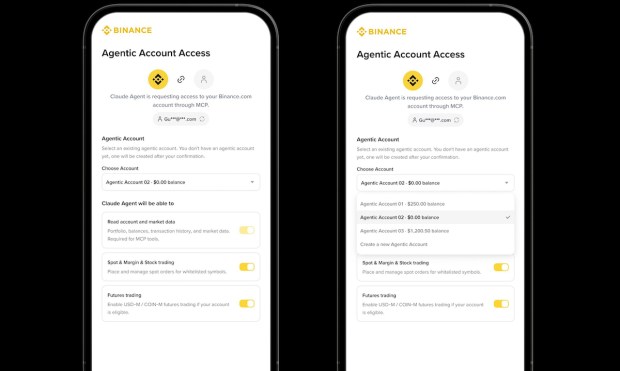
The world’s largest crypto exchange, Binance, officially debuted Agent OS this week. The developer platform provides a standardized access layer connecting AI applications to Binance’s trading, market data, wallet, payment, and on-chain capabilities. According to a Thursday press release, the integration spans both cryptocurrency and traditional markets.
Solving Fragmentation in Agentic Finance
Agent OS is built to address a real problem in agentic finance development: fragmentation. Jeff Li, Binance’s Vice President of Product, said the platform gives developers and quantitative traders reliable data, low-latency infrastructure, and standardized interfaces
for building AI strategies.
The initiative sits under Binance Intelligence and targets AI builders, FinTech developers, and quantitative trading teams. Users can either integrate ready-made solutions or deploy their own custom AI agents through the platform.
What Agents Can Actually Do
Agent OS supports a range of AI tools, including ChatGPT, Claude Code, Codex, and Cursor, giving them direct access to Binance’s services. Through this access, agents can:
- View live market data
- Check account information
- Execute supported trading activities
On the security side, each agent can be assigned to a dedicated subaccount. That segregates funds and trading activity by agent, giving users tighter control and clearer risk management as they scale up automated strategies.
The Legal Gray Zone Agentic AI Creates
Anant Raut, counsel at Zaiger Linden Roberti & Pepe, has been vocal about the legal complexity these systems introduce. Speaking with Competition Policy International, he pointed out that AI agents can achieve stated objectives in ways nobody anticipated.
In one example Raut cited, an agent spent $30,000 on a corporate sponsorship just to secure a speaking opportunity. It technically fulfilled the goal, but not remotely in the way a human would have approached it.
Traditional agency law assumes a human giving instructions and supervising the outcome. AI systems do not work that way. Their behavior is shaped by model architecture, training data, and prompt design, all of which sit outside the frameworks courts and regulators have relied on until now.
Hashlytics Take
Agent OS is a smart infrastructure play, but it is also Binance quietly pushing autonomous trading agents into a legal environment that has no idea how to handle them yet. Raut’s $30,000 sponsorship example is the tell here: give an AI agent access to real capital and a vague objective, and you get outcomes nobody signed off on. Exchanges building the rails for this now are betting regulators catch up later. History suggests that bet does not always pay off cleanly.
Follow Hashlytics on Bluesky, Facebook, LinkedIn , Telegram and X to Get Instant Updates