+1.15%
+2.41%
+4.35%
+2.21%
+0.24%
+0.76%
Trump’s Iran Negotiations Collapse Triggers Broader Market Selloff
Over the weekend, the Trump administration cancelled a diplomatic mission to Pakistan designed to restart negotiations with Iran. The move deepens the US-Israel-Iran conflict, now entering its second month of active hostilities. Iran responded by tightening restrictions on maritime shipments through the Strait of Hormuz, a critical chokepoint handling roughly 20% of global oil and natural gas flows.
Brent crude futures surged 2.58% to $101.69 per barrel, while West Texas Intermediate climbed 2.09% to $96.37. Iranian officials stated they will not return to talks until Washington lifts its blockade on Iranian ports, which they characterize as a violation of previous ceasefire agreements.
Why Geopolitical Risk Drives Crypto Volatility
Heightened uncertainty typically forces institutional and retail investors to abandon speculative assets. Bitcoin’s 2.25% decline reflects this classic “risk-off” behavior, as market participants seek defensive positions during periods of economic instability. The Strait of Hormuz disruption amplifies concerns about prolonged energy crises, further dampening appetite for volatile digital assets.
Historically, such geopolitical catalysts accelerate crypto sell-offs. However, Bitcoin’s rally is being rebuilt by institutions, suggesting longer-term conviction may persist despite short-term headwinds.
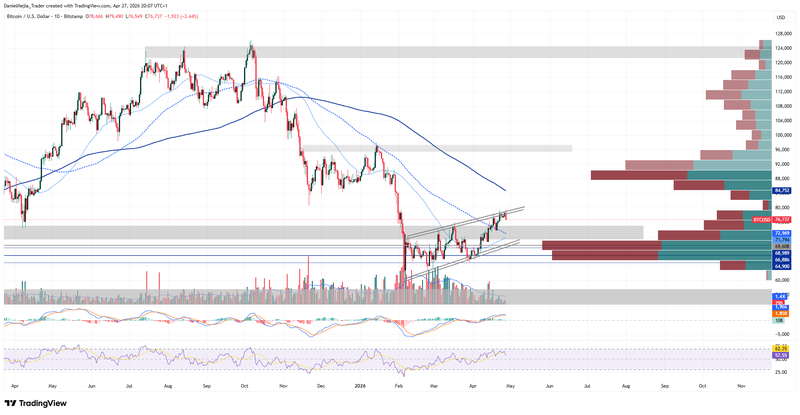
Bitcoin’s Technical Picture Remains Cautious
From a technical standpoint, Bitcoin is struggling within a consolidative range that has persisted for roughly two months. The asset trades below its 200-day Simple Moving Average, reinforcing a bearish bias on longer timeframes.
Key technical levels include:
- Immediate resistance near $79,000, with the next ceiling at $84,000 (coinciding with the 200-day SMA)
- Primary support at $70,000, with a critical floor at $62,000
- Moving Average Convergence Divergence (MACD) and Relative Strength Index (RSI) both trending upward but approaching overbought territory
A sustained break below $62,000 would likely accelerate selling pressure and trigger a deeper market correction. Meanwhile, Ethereum tests key technical levels amid rising institutional support in the crypto market, signaling mixed sentiment across digital assets.
Institutional Capital and Geopolitical Catalysts Dominate
Bitcoin’s near-term direction depends heavily on institutional capital flows and fundamental geopolitical developments. The broader crypto sector faces competing pressures: Ethereum slides as energy costs surge and geopolitical tensions persist, while simultaneously Charles Schwab enters the race for dominance in the cryptocurrency market.
Investors should monitor whether Iran and the US return to negotiations, as a diplomatic breakthrough could rapidly reverse risk aversion. Until then, Bitcoin remains trapped in a cautious consolidation, vulnerable to further downside if geopolitical tensions escalate further.
Follow Hashlytics on Bluesky, LinkedIn , Telegram and X to Get Instant Updates