Paystack Unveils Decade-First Dashboard Overhaul with AI Command Centre
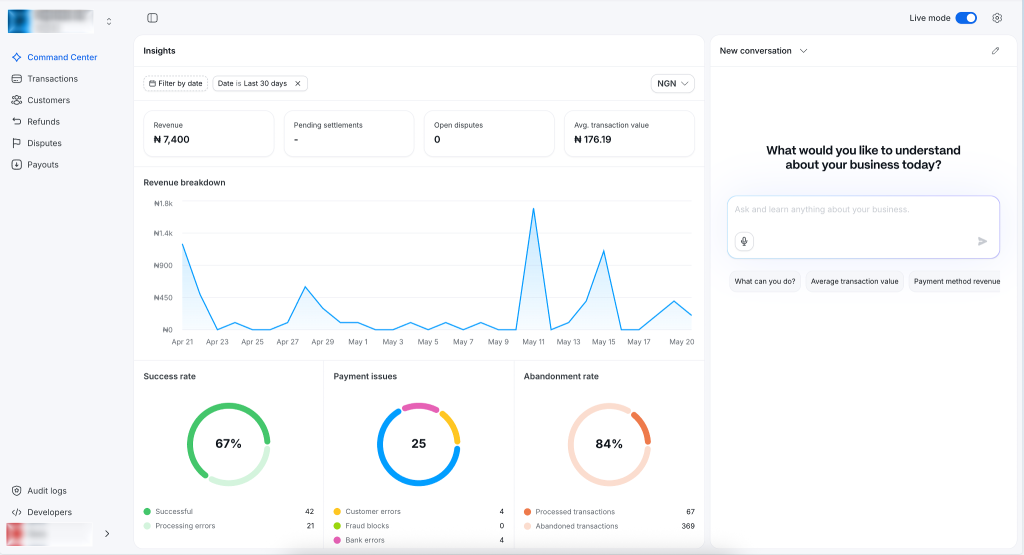
On Thursday, Paystack officially rolled out a fully rebuilt version of its Dashboard, a core platform for merchants to oversee transactions, track revenue, and manage customers. This comprehensive update introduces a revamped interface, a streamlined navigation system, and full mobile compatibility. The standout feature is the AI-driven Command Centre, which allows merchants to query their business data using conversational prompts.
AI Command Centre Revolutionizes Merchant Operations
Internally dubbed Canvas, the new AI-native Command Centre acts as a conversational interface embedded directly within the Dashboard. It leverages a merchant’s own transaction and operational data to provide real-time answers to business-related questions. Instead of navigating various pages, merchants can ask questions and receive responses in text, tables, or charts, according to the company.
Paystack emphasizes that the system ensures reliability and accuracy, grounding every response in actual merchant data through a “deterministic harness” to minimize hallucinations and maintain ties to verified operational records. Automated evaluation systems continuously test response quality against predefined baselines, and every request undergoes safety and compliance checks before a response is generated. The system utilizes a combination of GPT models, structured data retrieval, and an internal orchestration layer called Project Canvas API.
Responding to Evolving Merchant Needs and AI Trends
The extensive redesign reflects changing merchant behaviors and Paystack’s growth since its 2016 launch, when it aimed to be a cheaper and faster alternative for online payments in Nigeria. Senior Product Designer Dara Assim-Ita, who led the rebuild, noted that the old Dashboard’s structure became less intuitive as more capabilities were added. Internal research indicated that merchants often struggled to locate functions despite knowing their objectives. Furthermore, a PwC report highlights that 82% of African organizations are piloting AI, with the African AI market projected to reach $16.5 billion by 2030, underscoring the urgency for companies to integrate AI into workflows.
Redesigned Navigation and Mobile Parity Enhance User Experience
Beyond AI, the rebuild significantly addresses navigation and mobile accessibility. The Dashboard’s product offerings, which expanded over the past decade to include features like User Permissions (2019) and Audit Logs, have been reorganized into two primary sections: Payments and Products. Payments now houses operational workflows such as transactions, customers, and disputes, while Products accommodates newer modular offerings like transaction splits. A crucial aspect of the update is full parity between mobile and web, ensuring all features and screens are accessible across devices, addressing the increasing trend of merchants managing operations via smartphones.
Future-Proofing Fintech with AI at its Core
The redesign process, which involved research and design from November 2025 to early January 2026 and engineering development from mid-January to mid-April 2026, took approximately five months from conception to launch. Paystack’s approach aligns with a broader industry trend where conversational AI is integrated into existing software rather than launched as standalone tools. Assim-Ita stated, “This Dashboard is just the foundation. We think the companies that win in this next era of fintech will be the ones who treat AI not as a feature, but as a direction.” The current release focuses on core payment workflows, with more of Paystack’s products expected to migrate to the new architecture over time.
Follow Hashlytics on Bluesky, LinkedIn , Telegram and X to Get Instant Updates