+0.24%
-0.17%
-2.00%
+3.72%
+0.88%
-0.88%
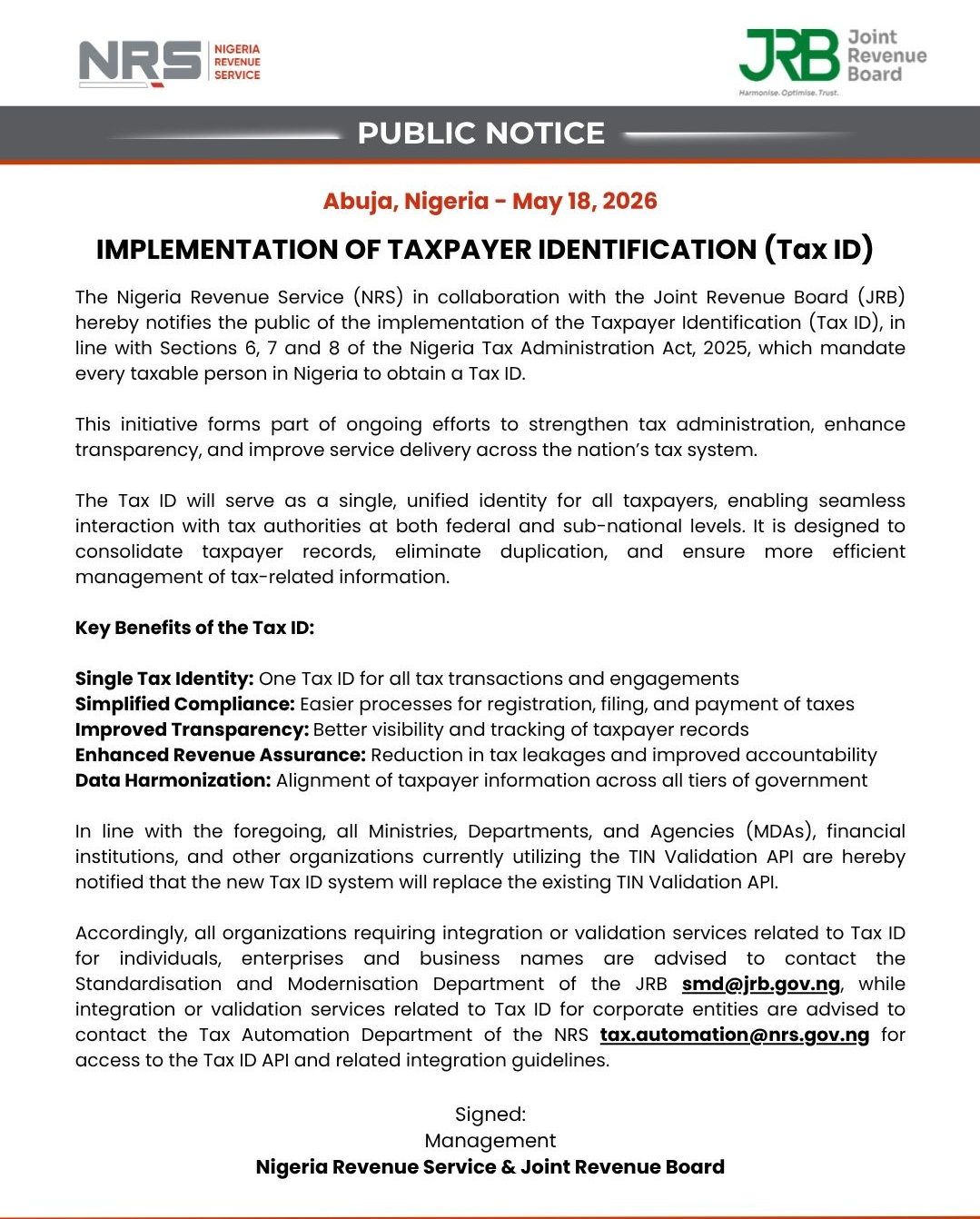
The Nigeria Revenue Service and Joint Revenue Board announced May 18, 2026 that the Taxpayer Identification (Tax ID) system has entered full implementation, replacing the TIN Validation API and mandating integration by all ministries, financial institutions, and organizations currently using tax verification services.
The infrastructure went live January 1, 2026 under Sections 6, 7, and 8 of the Nigeria Tax Administration Act 2025, automatically converting National Identification Numbers for individuals and Corporate Affairs Commission registration numbers for businesses into unified tax identifiers, creating a centralized financial surveillance system that tracks every taxable transaction through a single government-controlled identity layer.
What the Tax ID Actually Does Beyond Tax Collection
The NRS public notice frames Tax ID as administrative modernization: single unified identity for taxpayers, seamless interaction with authorities, consolidated records, eliminated duplication, efficient information management. The technical reality is more comprehensive. Every Nigerian’s NIN — already required for SIM cards, bank accounts, and government services — now automatically functions as their Tax ID.
Every registered business’s CAC number serves the same purpose. No separate application required, no physical card issued, no opt-out mechanism provided.
The system generates a 13-digit identifier linked to either NIN (individuals) or CAC registration (corporates) accessible through taxid.jrb.gov.ng or taxid.nrs.gov.ng. Retrieving your Tax ID requires entering personal information exactly as captured by NIMC or CAC databases. Once generated, that identifier becomes mandatory for banking, insurance, stock market transactions, government contracts, and any financial activity the Nigeria Tax Administration Act designates as requiring tax verification.
The shift from TIN Validation API to Tax ID API creates new data flow architecture. Previously, organizations queried FIRS to validate whether a given TIN existed and was active. The new system ties validation directly to NIMC and CAC identity databases, enabling real-time cross-referencing between tax records, biometric identity data, corporate registration information, and financial transactions. That integration didn’t exist under the old TIN system, which operated as a standalone tax identifier without mandatory links to national identity infrastructure.
Organizations requiring Tax ID integration must contact JRB’s Standardisation and Modernisation Department ([email protected]) for individuals/enterprises/business names or NRS’s Tax Automation Department ([email protected]) for corporate entities. The technical migration requires API integration, validation service reconfiguration, and systems updates across Nigeria’s financial sector—implementation complexity NRS addresses by mandating compliance rather than providing transition timelines or fallback mechanisms.
How This Connects to Nigeria’s Expanding Digital Identity Infrastructure
The Tax ID mandate doesn’t exist in isolation. It’s the latest layer in Nigeria’s expanding digital identity infrastructure that increasingly requires biometric verification, government-issued identifiers, and centralized databases for accessing financial services. Nigeria’s BVN policy locks phone numbers to banking identity, creating permanent linkage between mobile communications and financial access. The 2025 Tax Act clarifies digital asset taxation, bringing cryptocurrency and freelance income into formal tax reporting requirements.
Nigeria mandates crypto exchanges to report user IDs for tax compliance, requiring platforms to submit customer NINs, transaction volumes, and trading patterns to tax authorities. The Tax ID system provides the infrastructure layer enabling that reporting—exchanges validate user identity against Tax ID databases, submit transaction data tagged with those identifiers, and NRS cross-references crypto activity with income tax filings to detect discrepancies.
Each component reinforces the others. BVN links banking to biometric identity. Tax ID links that identity to NIMC’s national database. Crypto reporting requirements link digital asset activity to the Tax ID. Phone number registration links communications to BVN. The result is a comprehensive identity ecosystem where financial activity, biometric data, telecommunications, tax records, and government services operate through interconnected databases accessible to multiple agencies.
The Trust Deficit Nobody Addresses
Nigeria Risk Index analysis identified the fundamental challenge: a pre-existing trust deficit between government and citizens stemming from perceived inefficiencies and corruption. Tax ID implementation assumes Nigerians will willingly integrate their entire financial lives into centralized government databases managed by agencies with documented records of data mismanagement, unauthorized access, and security failures.
The system mandates that anyone without a valid Tax ID may find bank accounts effectively frozen starting January 1, 2026, compromising ability to pay bills or receive salary. That enforcement mechanism—financial exclusion for non-compliance—creates coercive pressure to participate regardless of trust concerns. The government positions this as necessary for bringing the informal economy into the formal tax net, but the trade-off is mandatory participation in financial surveillance infrastructure without meaningful consent mechanisms or privacy protections.
NRS emphasizes that Tax ID retrieval is “100% free” and warns citizens not to pay agents for the service. That guidance acknowledges the predictable emergence of intermediaries charging for what should be free government services—a pattern that consistently appears when Nigeria implements mandatory digital identity systems. The existence of such intermediaries suggests many citizens lack confidence in their ability to navigate government portals directly, creating opportunities for exploitation despite official zero-cost policy.
The automatic assignment of Tax IDs to anyone with BVN or NIN means millions of Nigerians received identifiers without explicit registration. NRS frames this as convenience—no application required, just retrieve your auto-generated number through the portal. The alternative framing is that the government unilaterally assigned tax tracking identifiers to the entire population without individual consent, then made those identifiers mandatory for financial access. Both descriptions are accurate. The difference is whether you prioritize administrative efficiency or individual agency.
What Happens to Crypto Users and Digital Economy Participants
The Tax ID mandate creates particular compliance challenges for cryptocurrency users and digital economy participants who historically operated outside formal tax reporting. Nigeria’s crypto tax plan faces regulatory roadblocks, but Tax ID implementation bypasses those roadblocks by creating identity verification requirements independent of specific crypto regulations.
Crypto exchanges operating in Nigeria must integrate Tax ID validation APIs to verify customer identity. That integration enables NRS to track which NINs are associated with exchange accounts, even without detailed transaction reporting. When combined with the existing mandate for exchanges to report user IDs and trading volumes, Tax ID creates comprehensive visibility into who participates in crypto markets and approximate activity levels.
Freelancers earning income through international platforms face similar exposure. Payment processors like Payoneer, PayPal, and Wise operating in Nigeria must verify customer Tax IDs when users cash out to Nigerian bank accounts. Cross-border income that previously evaded tax reporting becomes trackable when withdrawal transactions require Tax ID validation. The system doesn’t prevent offshore income—it creates audit trails when that income enters Nigeria’s banking system.
The ₦800,000 annual income threshold exempts small-scale traders and freelancers from income tax liability, but that exemption doesn’t eliminate Tax ID requirements. Even individuals below the threshold need Tax IDs to access banking services, creating population-wide visibility into financial activity regardless of whether specific transactions trigger tax obligations. The distinction between “tax identification” and “tax liability” collapses in practice when the identifier becomes mandatory for financial participation.
The Data Harmonization Problem NRS Doesn’t Mention
Tax ID relies on data accuracy across NIMC and CAC databases. NIMC’s NIN enrollment has documented issues with duplicate registrations, data entry errors, biometric capture failures, and incomplete records. CAC’s corporate registry contains companies with outdated ownership information, dissolved entities still showing as active, and registration details that haven’t been updated in years. Tax ID inherits those data quality problems while adding new dependencies.
When users retrieve Tax IDs through the portal, they must enter names and dates of birth “exactly as captured” by NIMC. But NIMC’s database contains spelling variations, nickname registrations instead of legal names, and birthdates that don’t match bank records because users provided different information to different agencies over the years. Those discrepancies create validation failures where citizens have legitimate NINs but cannot retrieve Tax IDs because their portal input doesn’t precisely match NIMC’s stored data.
For businesses, CAC registration numbers automatically become Tax IDs, but CAC records don’t systematically track beneficial ownership changes, director resignations, or corporate restructurings. A business’s Tax ID remains tied to its RC number even when ownership has completely changed, creating situations where tax liabilities follow corporate entities rather than the individuals who profited from taxable transactions. That works for identifying corporate tax obligations but fails when attempting to trace personal income through business structures.
The NRS public notice doesn’t address migration pathways for the millions of Nigerians with TINs issued before the January 2026 unification. The system “replaces previously issued TINs” but doesn’t clarify whether old TINs automatically map to new Tax IDs or require manual migration. Tax consultants report clients discovering their historical tax payment records aren’t linked to new Tax IDs, creating compliance disputes where documented tax payments appear absent from the unified system.
Why Financial Institutions Comply Without Resistance
Banks, insurance companies, and investment platforms integrate Tax ID validation not because they support centralized financial surveillance but because non-compliance carries regulatory consequences. The Central Bank of Nigeria can impose operating restrictions, the National Insurance Commission can suspend licenses, and the Securities and Exchange Commission can freeze trading authorizations for institutions that facilitate financial transactions without Tax ID verification.
That regulatory pressure creates perverse incentives where financial institutions become tax enforcement agents. Banks already serve as BVN enrollment points, KYC verification providers, and transaction monitoring systems for anti-money laundering compliance. Tax ID adds another layer of mandatory verification without corresponding liability protection when government databases contain inaccurate information that causes verification failures for legitimate customers.
The migration from TIN Validation API to Tax ID API imposes development costs, system integration expenses, and operational disruptions on financial institutions that must comply with government timelines regardless of readiness. Smaller banks, microfinance institutions, and fintech startups face disproportionate impacts—they lack the technical resources larger institutions use to manage API transitions, creating market consolidation pressure favoring organizations that can absorb compliance costs.
The Broader Pattern of Digital Identity Mandates
Nigeria’s Tax ID implementation follows a global pattern where governments introduce digital identity systems as administrative modernization while constructing comprehensive surveillance infrastructure. India’s Aadhaar system, initially voluntary, became effectively mandatory as more services required biometric authentication. China’s social credit system began as financial credit scoring before expanding into behavioral monitoring. Kenya’s Huduma Namba faced constitutional challenges over mandatory biometric registration without privacy protections.
Each system shares common characteristics: initial framing as optional or purely administrative, gradual expansion of required use cases, integration with financial services to create compliance pressure, centralized databases controlled by government agencies, and enforcement through service exclusion rather than criminal penalties. Tax ID exhibits all five patterns. The system launched as tax administration improvement, expanded to mandatory financial access requirements, integrated with banking and crypto platforms, centralized data through NRS and JRB databases, and enforces compliance by threatening account freezes.
The May 18, 2026 public notice confirms full implementation has begun. Organizations must integrate or face regulatory consequences. Citizens must participate or lose financial access. The infrastructure is operational, the mandates are active, and the surveillance capabilities are enabled. What remains unclear is whether Nigerians will accept this trade-off—comprehensive financial transparency in exchange for tax system efficiency—or whether resistance emerges as people discover the extent to which Tax ID enables monitoring of previously private financial activity.
What This Means for Privacy and Financial Autonomy
Tax ID creates a single government-controlled identifier required for all formal financial activity in Nigeria. That identifier links to biometric databases (NIMC), corporate registries (CAC), banking systems (BVN), telecommunications (SIM registration), and crypto exchanges (reporting mandates). The convergence of those systems means NRS can theoretically track when a specific NIN opens a bank account, registers a phone number, creates an exchange account, receives international payments, and conducts taxable transactions—all through a unified identifier the individual cannot opt out of without forfeiting financial participation.
Privacy advocates describe this architecture as “function creep”—systems introduced for narrow purposes gradually expanding into comprehensive surveillance. Tax ID’s stated purpose is eliminating duplication and improving tax administration. The technical capability it enables is real-time cross-referencing of financial activity across multiple databases using a mandatory government identifier. The distinction between stated purpose and enabled capability matters when governments change, political priorities shift, and infrastructure built for tax collection becomes repurposed for other surveillance objectives.
Financial autonomy requires the ability to transact without third-party visibility into your complete financial history. Tax ID structurally eliminates that autonomy for any Nigerian using formal financial services. The informal economy remains the only domain where Tax ID requirements don’t apply—cash transactions, community lending, and unregistered businesses operate outside the system. But NRS explicitly frames Tax ID as bringing the informal economy into the formal tax net, suggesting future enforcement will target those remaining spaces of financial privacy.
The system is operational. The mandates are enforceable. The integration is mandatory. Whether this represents necessary tax modernization or authoritarian financial surveillance depends heavily on how NRS exercises the capabilities Tax ID infrastructure provides. Historical patterns suggest governments rarely build surveillance systems and then voluntarily limit their use. More likely, Tax ID becomes the foundation for expanding financial monitoring as regulators discover new use cases the infrastructure enables. The question isn’t whether Nigeria has built comprehensive financial surveillance—it clearly has. The question is what comes next once the infrastructure is entrenched and reversal becomes technically and politically infeasible.
Follow us on Bluesky, LinkedIn, X, and Telegram to Get Instant Updates