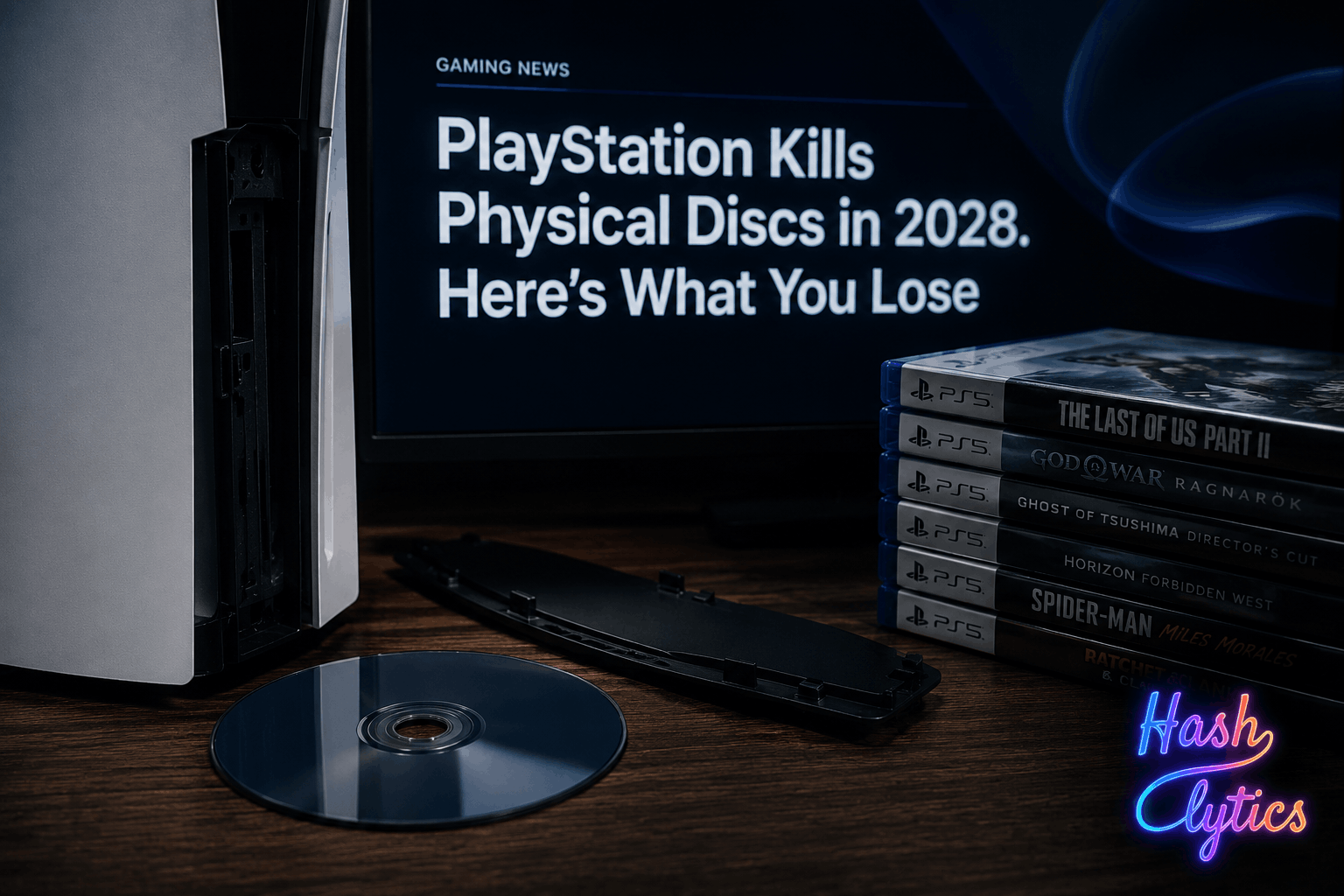
GTA 6 was the first major test. Take-Two’s physical version shipped as a download code in a box, no disc. From January 2028, every PlayStation game follows that model.
What This Confirms About the PS6
Ampere Analysis senior analyst Piers Harding-Rolls told Kotaku the January 2028 cutoff “pretty much guarantees PS6 won’t arrive until 2028 at the earliest,” with a late 2028 launch now the working assumption. Circana’s Mat Piscatella was more direct: “It is safe to now assume that both PlayStation 6 and Project Helix will be digital-only devices.” Microsoft’s next-generation console appears to be following Sony’s lead, ending a decade in which Sony positioned physical game sharing as its competitive advantage over Xbox.
For existing PS4 and PS5 disc owners, backwards compatibility on PS6 remains unconfirmed. Sony has not committed to an add-on disc drive. An optional external drive may appear, similar to the PS5 Slim’s detachable design, but nothing has been announced.
What Actually Disappears
- Used game market: No discs means no second-hand sales, no borrowing, no gifting physical copies
- Ownership: You purchase a licence, not a product. Sony can alter pricing, remove titles from the store, or shut down servers
- Game preservation: Physical copies are how archivists, museums, and researchers keep gaming history accessible. Digital-only removes that redundancy
- Retail competition: Without discs, there is no price competition between retailers. PlayStation Store becomes the de facto monopoly on day-one pricing
- Price reduction: Removing discs saves Sony manufacturing and distribution costs. None of that saving is being passed to consumers
The Cloud Gaming and PC Angle
The move accelerates PlayStation’s transition from a hardware company to a software and services platform. Sony paused first-party PC releases earlier this year, signalling a reassessment of how it distributes exclusives outside the PlayStation ecosystem. Going digital-only on console brings PlayStation’s distribution model closer to Steam’s than it has ever been, which is precisely why the loudest backlash is coming from users who say there is no longer a meaningful reason to buy PlayStation hardware over a PC.
Sony’s own data shows PlayStation game downloads were uncommon a decade ago and are now the norm, with as much as 80-85% of game sales already digital. The disc is not being killed from a position of strength over consumer resistance, but from a position where most consumers have already made the transition. The users who haven’t are the collectors, the rural players with slow internet, the resale market participants, and the game preservationists. Sony has decided they are an acceptable loss.
PS3 and PS Vita digital stores will also close in 2027, cutting off legitimate digital purchase options for two legacy platforms. Between the DRM questions raised earlier this year, the end of physical media, and the PS3/Vita store closures, the direction is consistent: Sony is restructuring PlayStation around a closed, recurring-revenue digital ecosystem where the company controls every transaction. Whether that ecosystem remains worth buying into without the option of physical ownership is the question the PS6 launch will answer.
Follow us on Bluesky, LinkedIn, X, and Telegram to Get Instant Updates