
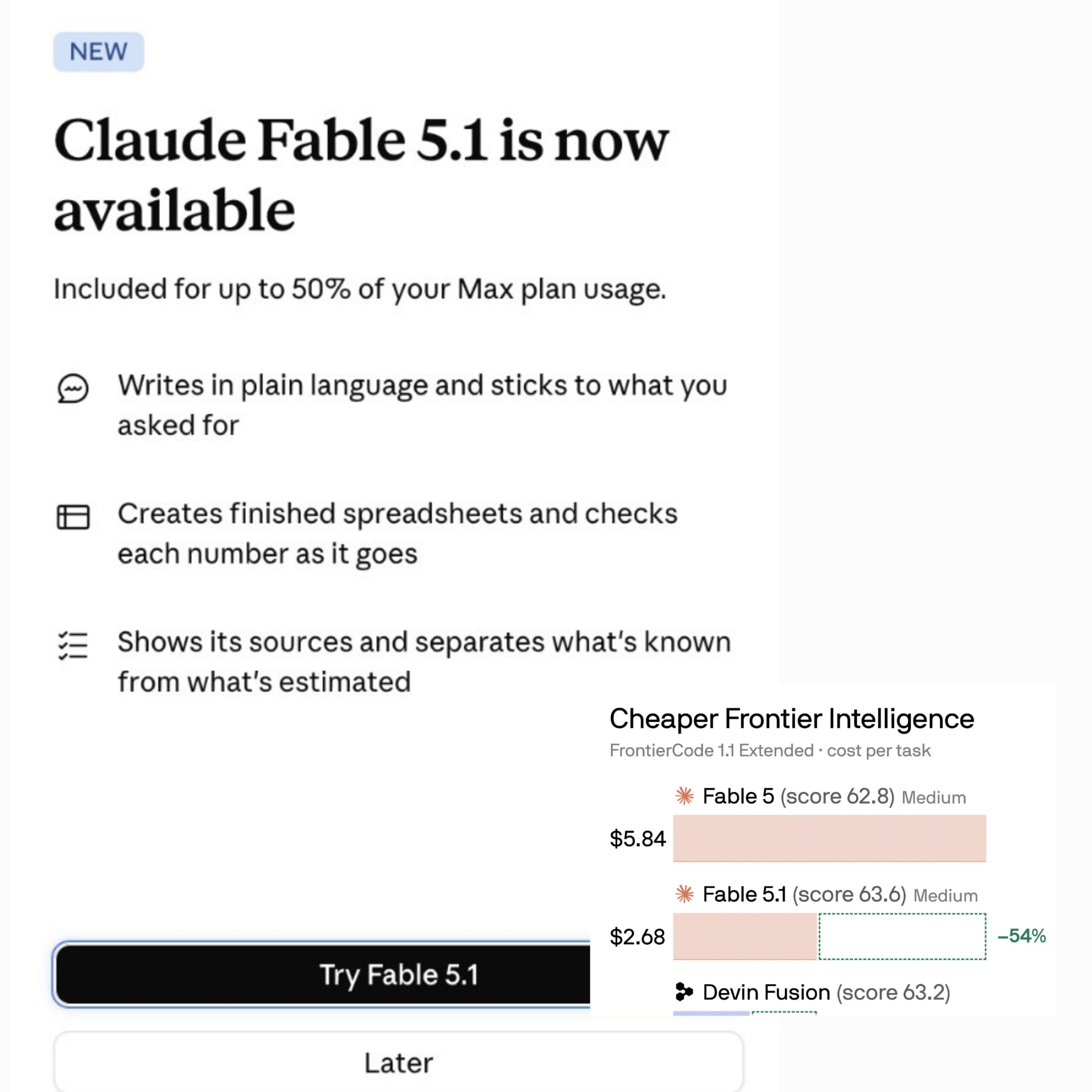
What Actually Changed Over Fable 5
- Cache reads cut 75%, from $1.00 to $0.25 per million tokens. List price holds at $10 input / $50 output. For typical workloads this saves about 25%. For highly agentic workflows that repeatedly reference large codebases, Anthropic estimates up to 45% savings, validated against four weeks of August enterprise customer data
- Terminal-Bench-Science more than doubled, from 24.7 to 52.6, the most dramatic single-benchmark gain in the launch table
- Mid-conversation effort control (beta): dial compute up or down mid-session without starting over
- Content provenance tracking (beta): outputs now carry a watermark compliant with the EU AI Act’s Code of Practice on AI-generated content transparency, invisible without the detection tool
- Zero-data-retention agreements now supported, previously a major barrier to enterprise adoption
- Fewer false positives on safety filters, addressing the core complaint that Fable 5’s safety layer triggered user backlash
How It Stacks Up Against GPT-5.6 Sol and Gemini
On Anthropic’s own launch table, Fable 5.1 leads GPT-5.6 Sol across every benchmarked row, and bests Fable 5 and Opus 5 on all seven. GPT-5.6 Sol’s promotional API pricing is $4 input / $20 output, making it 60% cheaper at list before caching. Sol’s voice and GPT-Live integrations remain areas Fable 5.1 does not directly compete on. Gemini 3.7 Flash at $0.75/$3.75 introductory targets a different cost tier entirely. The benchmark from the image you see above, FrontierCode 1.1 Extended, shows Fable 5.1 at $2.68 per task against Fable 5’s $5.84, a 54% cost reduction per completed task, while Devin Fusion at $1.43 remains 47% cheaper still on cost per task, despite similar capability scores around 63.
Our Take
The every.to team’s real-world verdict captures the product shift accurately: Anthropic built a supergenius that was too slow, too argumentative, and too expensive to actually deploy. Fable 5.1 addresses all three. The cache cost reduction is the move that matters most for enterprise teams running agents with large, repeated context windows, which is the majority of serious production deployments. Fable 5 was always capable. The problem was that capability without cost efficiency is a prototype, not a product. The EU AI Act watermarking compliance is also notable: Anthropic is the first major lab to ship this as a default for new model releases, which positions it well in European enterprise procurement. The remaining gap is pricing relative to GPT-5.6 Sol at list. Even with 45% agentic savings, Fable 5.1 costs more per token than Sol, and enterprise teams watching ServiceNow burn through their Anthropic budget in a month will feel that gap. The zero-data-retention support is Anthropic’s answer: capability-sensitive enterprises that cannot use Sol due to data residency concerns now have a frontier option that meets their compliance requirements.
Follow us on Bluesky, LinkedIn, X, and Telegram to Get Instant Updates